

Day 8, Monday, July 23rd: Aalborg – Hundelev
Weather: (very) cloudy, then sunny
Kilometres cycled: 69
Route:
Jultland Route
Aalborg, Nørre Halne, Øster Hjermitslev, Stenum, Hundelev
 I visited this museum yesterday. When you walk through the Algade, you hardly notice this lift. The bus driver (‘what are you doing in the rain on a Sunday afternoon in Aalborg??’) recommended it to me: ‘at least you’ll stay dry’. A good tip…
The Gråbrødrekloster Museet (the Gråbrødrekloster = monastery of the Grey Brothers). This museum lies three metres below the Algade and can only be reached by a lift. It is the foundations and parts of the wall of the Franciscan monastery, dating from 1250. The exhibition tells the story of life and death in the age of the Vikings and the Middle Ages.
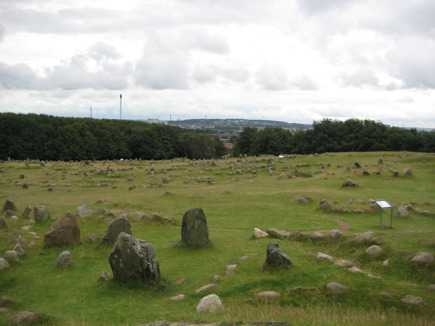
Lindholm Høje is one of the most significant monuments of Danish history. From 1889, it was known that there was a graveyard on the southern slopes of the Voerbjerg, as the hill was formerly called, with cremation-graves surrounded by stones.
The entire graveyard was exposed between 1952 and 1958. A recently ploughed field from the Viking period was also found and many of the settlements to which the graveyard belonged. When the excavations were completed, the whole area was sown with grass.
For almost a thousand years, the graves were covered by a layer of shifting sands, sometimes four metres thick. In this way, the graveyard has remained completely intact. It was used from about 400 A.D. to shortly before the year 1000. The oldest graves on the top and the youngest at the foot of the hill, altogether 41 graves, ordinary burials not marked by gravestones. The remainder of the almost 700 graves are cremation-graves where the cremation took place during the service. Most of these graves are surrounded by stones of different shapes: triangular, oval or in the shape of a ship.
It has been discovered that the graves are grouped by gender, since the men were usually buried in triangular or ship-shaped stone-formations and the women in ovals or circles.
Today I’m cycling a rather boring route, maybe caused by the weather.
North of Aalborg, the landscape is flat and monotonous. However, the sky is interesting: beautiful cloud formations cause me to look up more than at the road. (But, as said before: there is hardly any traffic).

Church in Stenum, the bell was being rung by hand.
I usually rest near a church. There are various reasons for this: there is always a seat, always a toilet, always a tap in the graveyard. Very cycle-holiday friendly.
Dag 9, dinsdag 24 juli: Hundelev - Skagen
Weer: ’s ochtends bewolkt, daarna zon
Aantal gefietste km.: 69
Route
Jutlandroute / Nationale route 1
Hundelev, Gammel Vennebjerg, Slettingen, Nørre Tornby, Hirtshals, Tversted, Skiveren, Lodskovvad, Hulsig, Tranestederne, Skagen Klitplantage
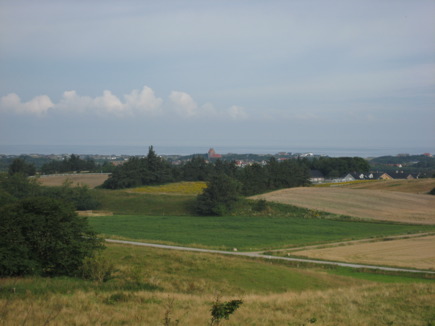
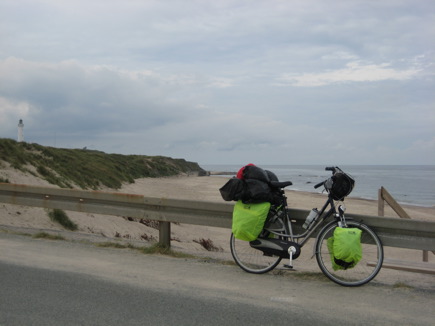
The Vennebjerg Kirke lies on the top of a 68-metre-high hill, the Gammel Vennebjerg. The height serves as a sea beacon and provides a wonderful view of the dunes and the high and dry lighthouse of Rubjerg Knude and the coastal town, Lønstrup with the sea behind it. This is a favourite artists’ haunt.
Råbjerg Mile in the Bunken Klitplantage is a rare natural phenomenon of shifting dunes that have been blown four kilometres inland by the wind. Each year they move eight metres eastwards.
Day 10, Wednesday, July 25th: Skagen – Frederikshavn
Weather: cloudy in the morning, sunny after 10 o’clock and a strong headwind
Kilometres cycled: 58
Route:
National Route no. 5
Skagen Klitplantage, Skeagen, Tranesterne, Hulsig, Ålbæk, Jerup, Strandby, Frederikshavn


The “silted up” or “buried” church
The Tilsandede Kirke, about 3 km south of Skagen, was built in the 14th century and was the largest in the area. In the 16th century, sand started to be blown by the wind and heaped against the church. By the 18th century, one had to dig one’s way into the church. In 1895, the church was closed for good and since 1910, only the tower sticks out above the sand. For years it was a beacon for sailors.


Skagens Odde near Grenen, in bare feet on the northernmost point of Denmark


My left foot in the Skagerrak and my right in the Kattegat and here the two seas collide with each other
 Skagen, with 12.000 inhabitants, lies on a peninsula where the Skagerrak and the Kattegat meet with a flourish. The wind and the clear skies make Skagen a favourite holiday resort and a place where many artists live, mostly painters.
At the end of the Østre Strandvej, an example of what the first lighthouse looked like stands on a dune: Vippefreyet: a long pole with a fire-beacon hanging on the end.
A little further to the east, the road stops in Grenen and the grave of the poet/painter, Holger Drachmann (1902). The peninsula grows constantly by several hundred metres a year, as currents deposit debris from other parts of the coast. Thus the grey lighthouse still stood in the middle of the sea in 1858. Now it is several kilometres inland.
Knivholt Hovdegård lies a little to the west of Frederikhavn. This is where I want to spend the night and, according to the booklet, there should be water, a toilet and a shower. The site is an enormous collection of buildings, best described as a farm with a stud.
It is very quiet, nobody to be seen, but meanwhile I have found the campsite with shelters (however no water, toilet or shower). I wander round the huge area and eventually meet someone, a woman who knows nothing of camping but can show me the toilet and a kitchen I can make use of.
She is the head of a crèche in one of the buildings and works there every day. “How long do you need for a shower?” Eh, why…?? “ I’m going home in quarter of an hour and as long as I am here, you can shower”.
The shower in the crèche is hardly used, judging by all the stuff stowed there. She clears a bit of space for me (“please don’t splash too much, otherwise everything will get wet!”) and, after a very necessary shower, during which I don’t manage to keep everything dry after all, she insists on drying it all herself. “You have a nice rest, you’ve been cycling all day”. Hm, true, but it seems to me that her work with toddlers and young children is far more tiring.
Whatever, extremely nice.
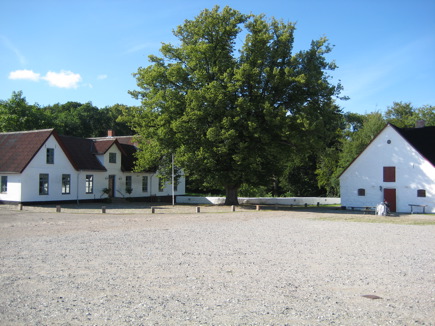

Camp site in Frederikshavn, Knivholt Hovedgård
Day 11, Thursday, July 26th: Frederikshavn – Gåser
Weather: mostly cloudy, rain and (strong) wind in the evening
Kilometres cycled: 83
1 flat tyre
Route:
National route 5 / Regional route 23
Frederikshavn, Sæby, Solsbæk, Voerså, Asaa, Gerå, Melholt, Hals, Glåser
Not a nice route today. Strong head-wind, a flat, busy road with mostly Germans, who have appropriated this part of Denmark, racing past.
Day 12, Friday, July 27th: Gåser – Hem
Weather: many showers, sun too, strong head-wind
Kilometres cycled: 80
Route:
Regional route 23 / National route 5 / Regional routes 18 and 26
Bike: Gåser, Hals
Ferry: Hals – Egense
Bike: Egense, Dokkedal, Smidie, Solbjerg, Veddum, Skelund, Hadsund, Norup, Assens, Mariager, Hem

Kerk bij Veddum. Sometimes it is a sport to find a place to shelter before the shower starts. Didn’t always work…

If a nature campsite has a toilet at all, it is something like this. This one is in Hem, near Mariager.
Day 13, Saturday July 28th: Hem – Århus
Weather: lot of sun, occasional shower, lot of hard wind
Kilometres cycled: 83
Route:
Regional route 18
Hem, Kærby, Spentrup, Randers, Kristrup, Ølst, Voldum, Ødum, Selling, Grundfør, Ølsted, Vejby, Århus

Randers, Sankt Mortens Kirke. The church is easy to find: I can hear the bells ringing from afar.
Day 14, Sunday July 29th: Århus – Kærby (Sjælland)
“Day of rest”
Weather: sunny
Kilometres cycled: 20
Route:
National route 4
Ferry: Århus – Kalundborg
Bike: Kalundborg, Tømmerup, Kærby
 The plan is to explore Århus this morning and take the boat to Sjælland this afternoon. But as I do more often on this holiday, I let my plans be led by the weather. It is going to rain this afternoon and when I left the campsite this morning (in the garden of a restaurant, 6 km. south-west of the city) it was already cloudy. I feel it’s a pity to have to make my first Big Crossing in the rain so I take the 10 o’clock boat. I’ll explore Århus some other time if I happen to be near it.
But weather wouldn’t be weather if it didn’t often change its mind. Like today. On the photos you can see that I leave a cloudy Århus and go to a sunny Kalundborg. It stays dry and sunny all day.
This is the first time in my life (I think) that I have been on a ferry. It is another half an hour before the boat leaves and during that time I go and explore. You have to know the best spot to settle down in and where the best place is to jump overboard in case of emergency.
I feel very welcome in Kalundborg. I have just arrived and look at my map. Immediately, a friendly young man comes along and asks if I can find what I want. He shows me the shortest way to the centre where I want to go.
There is a flea market in the town (Loppemarked). The sun and the cheerful music make it very pleasant. An old lady comes up to me and begins to talk to me in Danish. Saying “Jeg taler ikke Dansk”, I make it clear to her that I don’t speak Danish. She laughs and says, “ Og jeg taler ikke Engelsk” (= and I don’t speak English). But with some gestures we manage to make things clear to each other. When she hears where I have come from and am cycling round her beloved Denmark, she puts her hand to her mouth, grabs my arms and says a lot of nice things (I think). She kisses me on the cheek and wishes me a good journey: “God rejse!”
Unfortunately, the tourist office is closed, but sometimes the local people can tell you something, or more. Sitting on a bench, I eat my lunch and get talking to two ladies of about sixty. The sister of one of them has a stall on the market and I must go and see it. After half an hour, I know which of the people from Kalundborg are on the flea market, who is related to who and what they are selling. And at whose stall I must definitely not buy anything, and where I may.
I point to the map and ask if Route 4 is a nice one. They say it is. “Yes, lovely, but so is this one, and this and this …”
Sailing over the Store Belt, you can already see the five great towers of a brick church from afar. The Church of Our Lady of Kalundborg is of a respectable age: it was completed in 1172. What makes the For Frue Kirke so unique is not the bricks used for building – already often used in the 12th century – but the ground plan. In Northern Europe, a Greek cross was most unusual at that time. Each of its four arms is crowned by an octagonal tower, named after a female saint: Gertrud, Anna, Catharina and Maria Magdalena.
The central tower, 44 metres high, collapsed in 1827 and was only rebuilt 40 years later, on which occasion the other four towers were given a new spire. Altogether, the imposing building looks more like a fortress than a church and that was actually the builder, Esbern Snare’s intention. The interior confirms the impression that Esbern, who went on long voyages, was influenced by the Italian-Byzantine
The height of hospitality …
On arrival, I see a note on the front door, in Danish. I gather that cyclists are welcome and that one can reach the owners by telephone.
I decide to try the latter and Mr. Stavnskær answers. He says he is in Copenhagen and won’t be back till late that night. “Isn’t the door open?” I try it. No. “I think the key is in the shed, have a look”. “Is it there?” I look. No. “Then I will ring my son who lives near and he’ll open the door for you. Then at least you will be able to use the shower and toilet. Put your tent up in the garden”.
