

Click on the photos to enlarge
And suddenly there’s Japan amongst all my Denmark stories. Why Japan?
For some years, I have worked at the Dutch Carillon School in Amersfoort. As this is the only place in the world where you can get a Bachelor’s and Master’s degree in this subject, students come from all over the world, amongst others from Japan, where there are three carillons. I became friends with one of these students, Erico, who, after getting her Bachelor’s degree, left in September 2007 to return to Japan for good. Unexpectedly, I had the financial means to go to Japan and jumped at the chance.
Chiaki, another student, went back to Japan the year before and I shall also visit her. Together with her and Erico, I have made a sort of timetable so that I shall be able to enjoy as much as possible of the country.
So what does a holiday-cyclist going to Japan for a month do? Exactly. Make a plan for a short midweek cycling holiday.
During the exchange of emails before leaving, Chiaki subtly makes it clear that it is not very wise to cycle through Japan. “Do you realise that Japan is not so flat as Holland?” “In Tokyo recently, someone was murdered on the street with a knife”. When I tell her that, besides camping, I plan to make use of Couch Surfing, this is definitely discouraged: not in Japan, much too dangerous! (Couch Surfing is an international network of travellers who put their ‘couch’ at the disposal of other travellers, thus giving them a free bed for the night, see www. couchsurfing.com).
Meanwhile, Erico is finding out where I could rent a good bike and whether cycle routes exist. She agrees with Chiaki too but is less worried (and knows me a bit better).
During the weeks prior to my departure, one thing becomes clear: cycling through Japan is impossible. Firstly, because it is apparently too dangerous for a woman alone and secondly, because you cannot cycle because of the high mountains and bad roads. I would have taken this seriously, had I not read so much about cycling holidays in Japan, both in books and periodicals and on internet, even by women who had traversed the whole of Japan by bike on their own. What struck me from all these stories was the hospitality and helpfulness of the Japanese and their exaggerated worries. According to the Japanese themselves, Japan is a dreadfully dangerous country and, according to foreigners who have visited or lived there, Japan is just about the safest country in the world.
Well ... then what do you do? I was convinced it was possible. It would be a shame to miss this chance – probably the only time I could go to Japan. However, I don’t want to upset my friends. Eventually, I decide to go after all.
Unfortunately, a week before leaving, I have to change my plans. The bike itself is no problem – I can rent one there. Erico thinks she has found something suitable. A beautiful route has also been found – a marked route round Biwa-Ko, the largest lake in Japan, near Moriyama, the town where Erico lives. The problem is all the things you need for a cycling and camping holiday. In spite of everything being light-weight and not taking my cooking things, my luggage is well over the 20 kilos. Nor do I want to leave my clarinet at home. But that is already in the hand-luggage and doesn’t count.
I mail Chiaki and Erico that I won’t be doing the cycle-trip, but want to do little day-trips. That will make a lot of difference. I also think this will please Erico and Chiaki and, even better, set their minds at rest. They will be so relieved, especially Chiaki!
And surprise, surprise! A day before leaving, I get a mail from Chiaki with a photo of a beautiful light-weight tent. Dirt cheap. Chiaki asks me to answer by return so that she can order it. Then it will be there in time for me to use.
If I may generalise for a moment: if the Japanese are unable to dissuade you from your crazy plans and have resigned themselves to that, they will then do everything in their power to help you realise them, whether they agree or not.
The tent. What am I to do? My case is packed, 20 kilos exactly. If I have to take my cycle-bags, sleeping-bag, mattress, cycling gear and everything ... no, it’s impossible. I mail Chiaki immediately and explain that it is not only the tent, but all the rest, giving her the entire list. So, thank you very much for the wonderful offer, but I shall stick to my day-trips.
The only thing I take for cycling is a bag for the handle-bars. Borrowed from my aunt Jannie, it is ideal for this trip, light-weight, can be packed flat in my case, but big enough for putting all sorts of things in it.
On October 15th, 2008, I leave for Osaka, via Dubai. I arrive the following day and Chiaki and her parents fetch me from the airport, take me to the Central Station in Osaka (an hour’s drive), where I can get the train to Moriyama, the town where Erico lives (another hour).
The first hours I spend in Japan, I look round in amazement. Really everything is different! On the motorway (they drive on the left in Japan), I see very futuristic-looking cars, from which a Man from Mars could emerge any minute. I certainly wouldn’t be surprised.
Skyscrapers everywhere, neon lights and roads running under and over and next to each other (I’m not used to much).
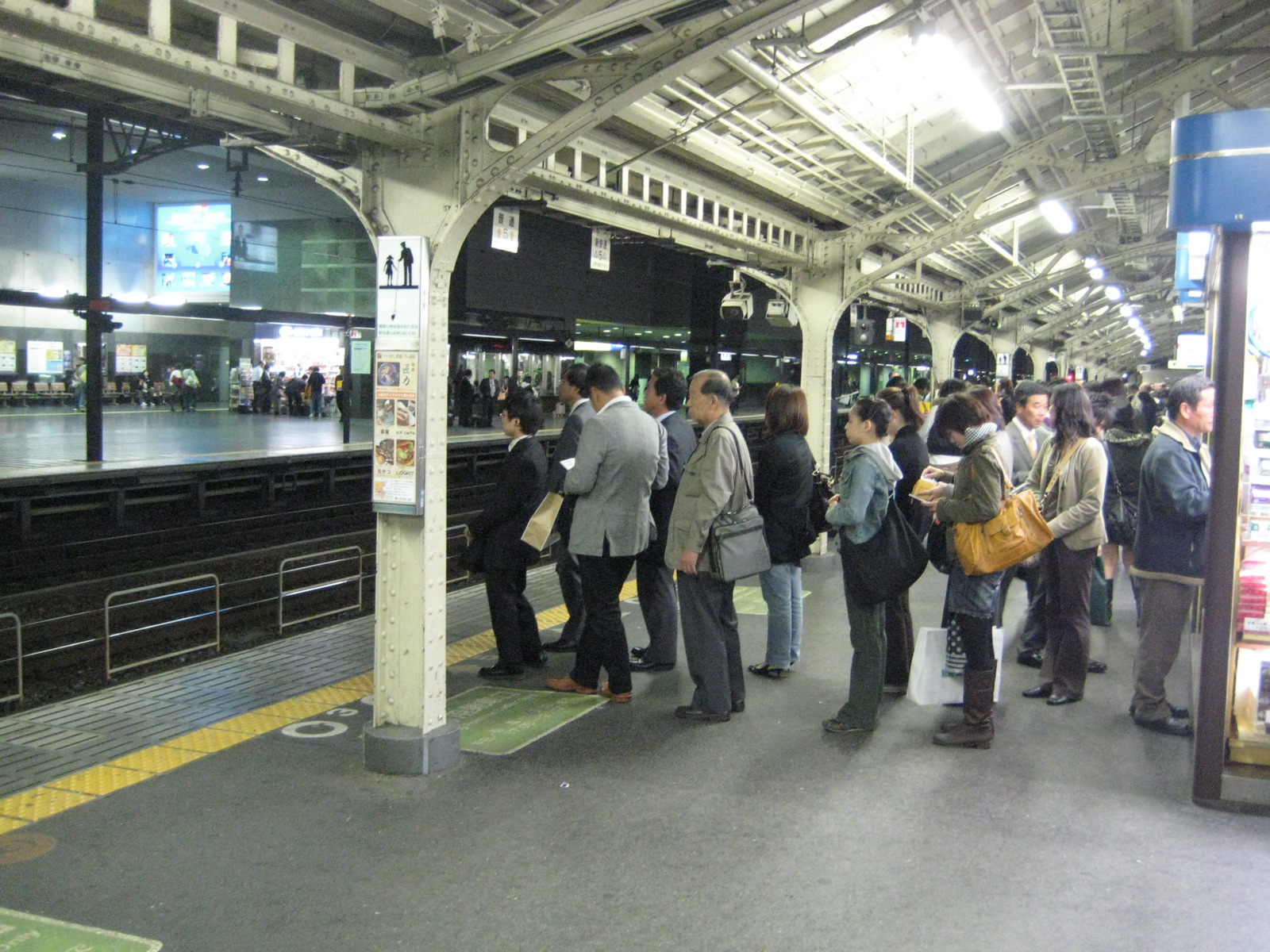
And then the JR! Japanese Railways versus the Dutch Railways: the trains run exactly on time. This alone is a miracle to me. On the platform, people wait patiently in rows of two abreast, a few metres between each row. The place where the train stops and where there is a door is precisely marked and everyone is polite enough to join the back of the queue when they arrive on the platform. A strange sight.
Chiaki has written down for me how Moriyama is written in Japanese and at what time the train will arrive. She assures me that the train will be exactly on time. “And Erico will be waiting for you where you get off”.
“But if the train stops further along?”
“Won’t happen, truly”.
“And if the train is late?”
“It won’t be, believe me”.
At first I have to stand in the train, feeling like a giant among all the little Japanese. But nobody seems to notice me. However ... later I discover that the Japanese do their very best not to let people notice that they have seen you.
A little later I can sit down, next to a window. As it is dark, I can’t see much, but at least I am less conspicuous (I think). In my bag I have a little cake, saved from the plane. I’m very hungry but have no idea whether eating in public is allowed in Japan. I have a useful book with me about ‘how to behave in Japan’ but can’t find anything about eating cakes in the train. I gobble it up quickly behind my hand. Later I find out that people take whole meals with them in the train to eat together. Another funny thing: in a Japanese train you can turn your seat round. So you can choose whether to sit opposite someone or behind them and whether to travel backwards or forwards.
Clever chaps, the Japanese.


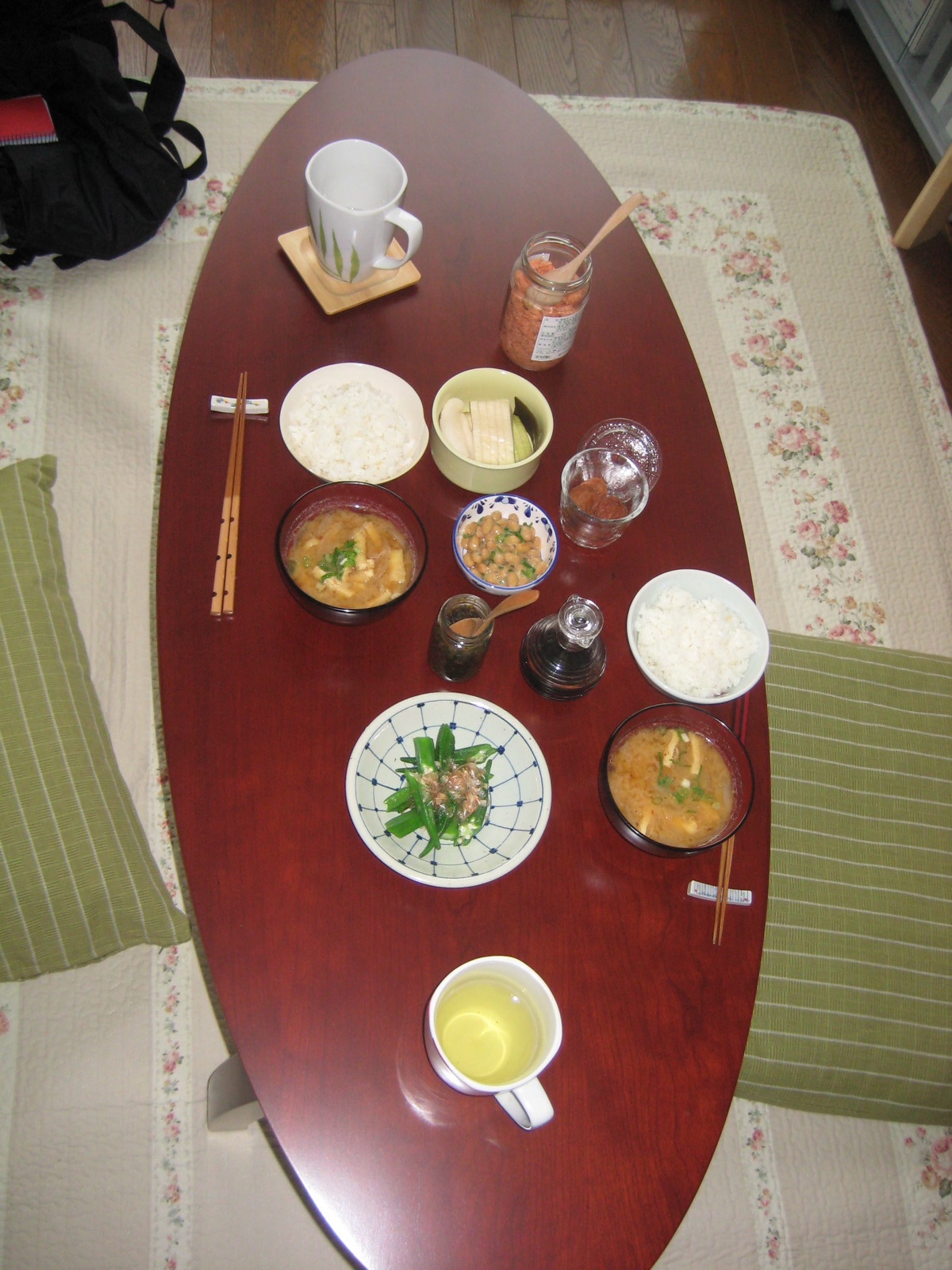
It is lovely to see Erico again. She lives only five minutes’ walk from the station, like many Japanese, in a tiny 1-room flat.
Many people had promised me jetlag but, in spite of the fact that it is 7 hours earlier in Japan (8 after this weekend, because of winter-time), I don’t feel anything. On the first night I sleep very well on my futon, a mattress that is folded up and put in a cupboard next morning.
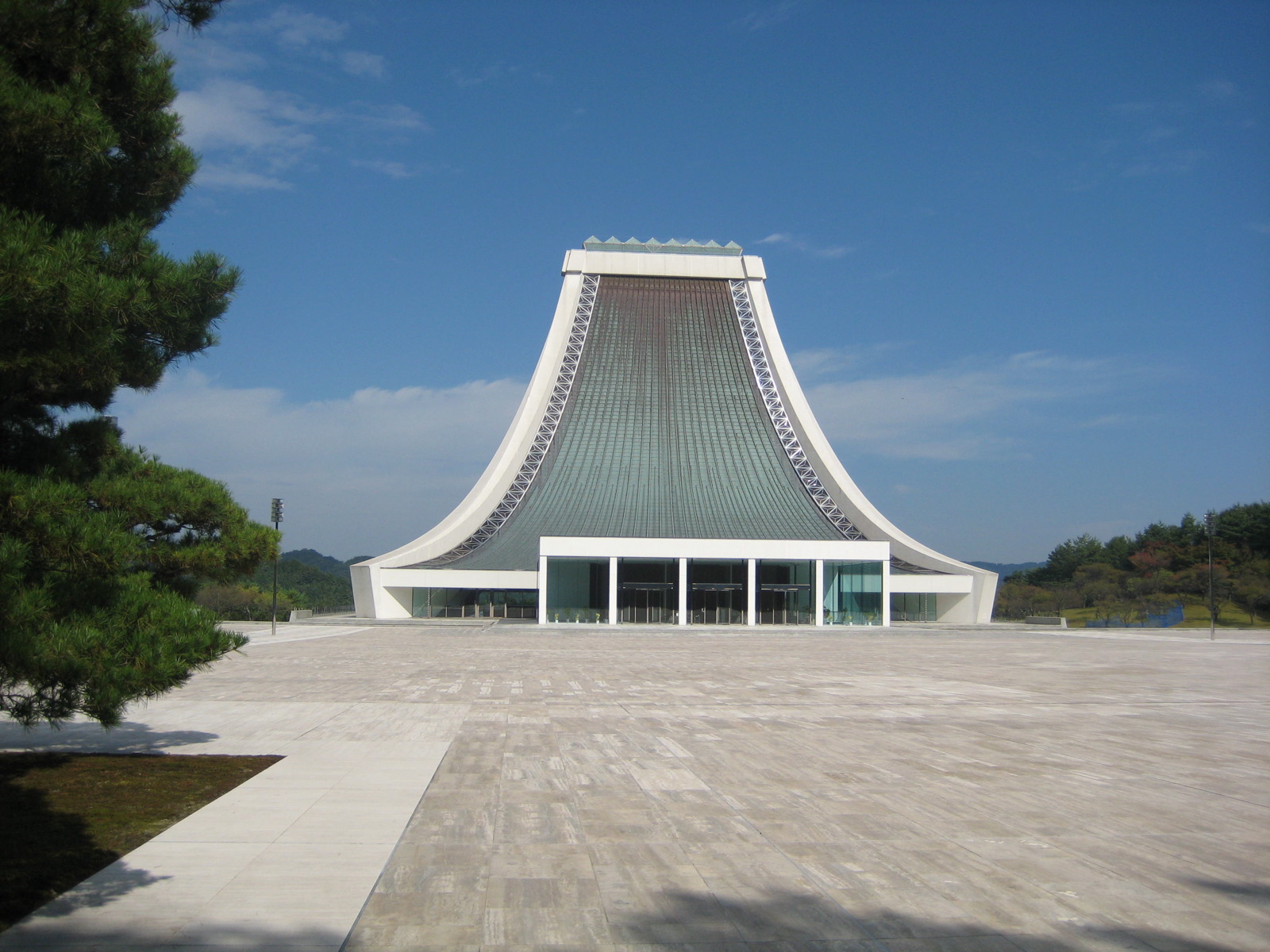
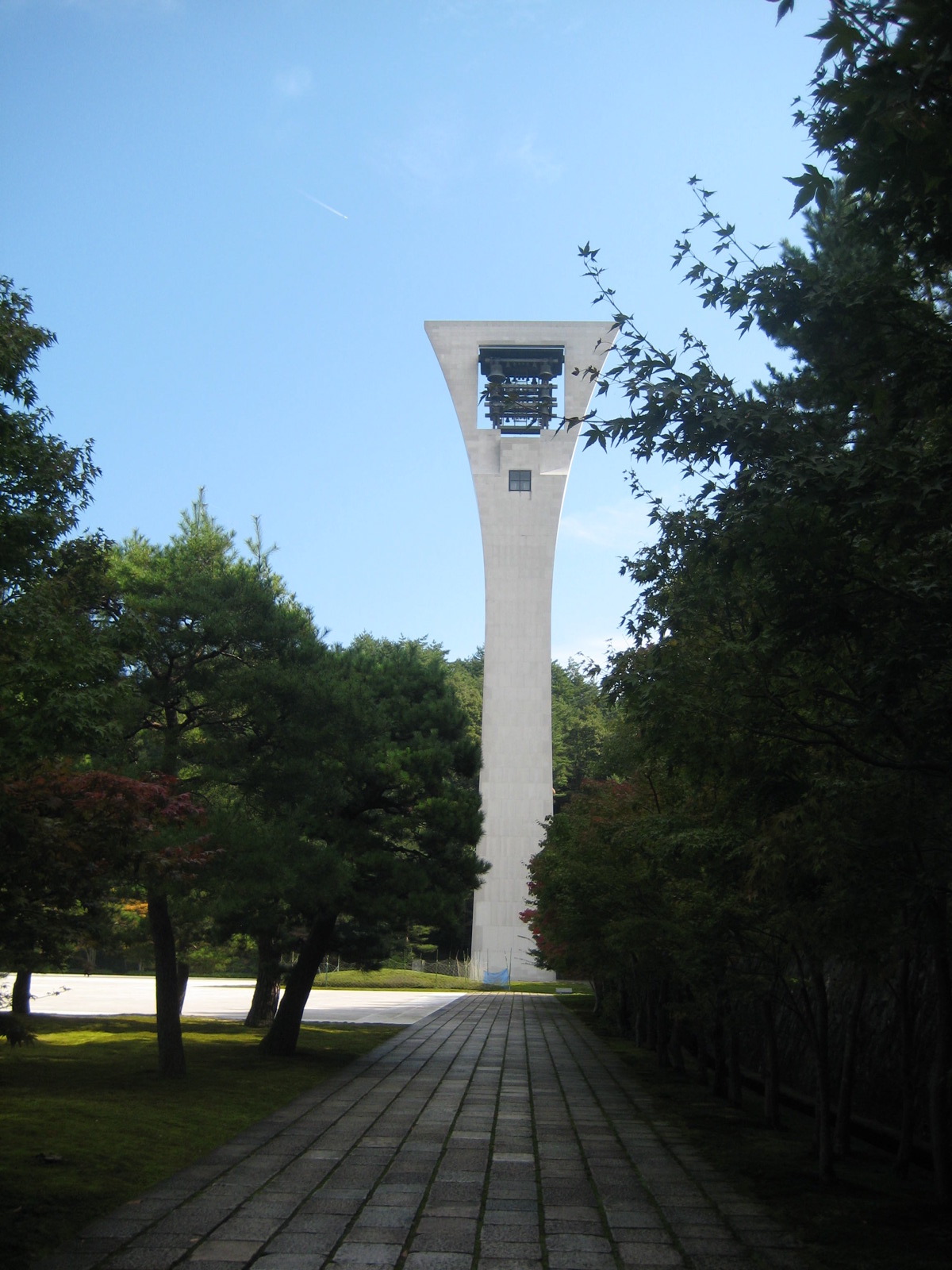
On the first day, Erico takes me with her to work. She is a member of the Shinji Shumekai, a religious group that has its ‘headquarters’ in Misono. There is an enormous temple there with a tower and carillon on the edge of the temple square. Erico works there in the ‘church’ office and plays the carillon regularly. A little further on is the famous Miho Museum which is also part of the Shinji Shumekai (a beautiful museum, by the way, see www. miho.or.jp).
With Erico, I visit the temple, the carillon and the museum in Misono. The surroundings are beautiful, in the middle of the mountains.


At the end of the day, Erico has a surprise for me. She has just had a call from Chiaki that she has organised camping things (which I may borrow from a colleague of a friend of Chiaki’s ...). Erico has also found a second-hand bike that I can buy for € 20. A friend of one of her colleagues had seen on television that there was a bicycle-shop that sold second-hand bikes. Possibly the only one in Japan and not far from Moriyama.
Now I must explain that if you need help in Japan, there will always be a nephew, a colleague or a great-aunt of your friend, your grandfather or your second cousin who could help you.
The other way round works as well: “I have a colleague whose friend’s daughter ... I wonder if you could ... for her, etc.”
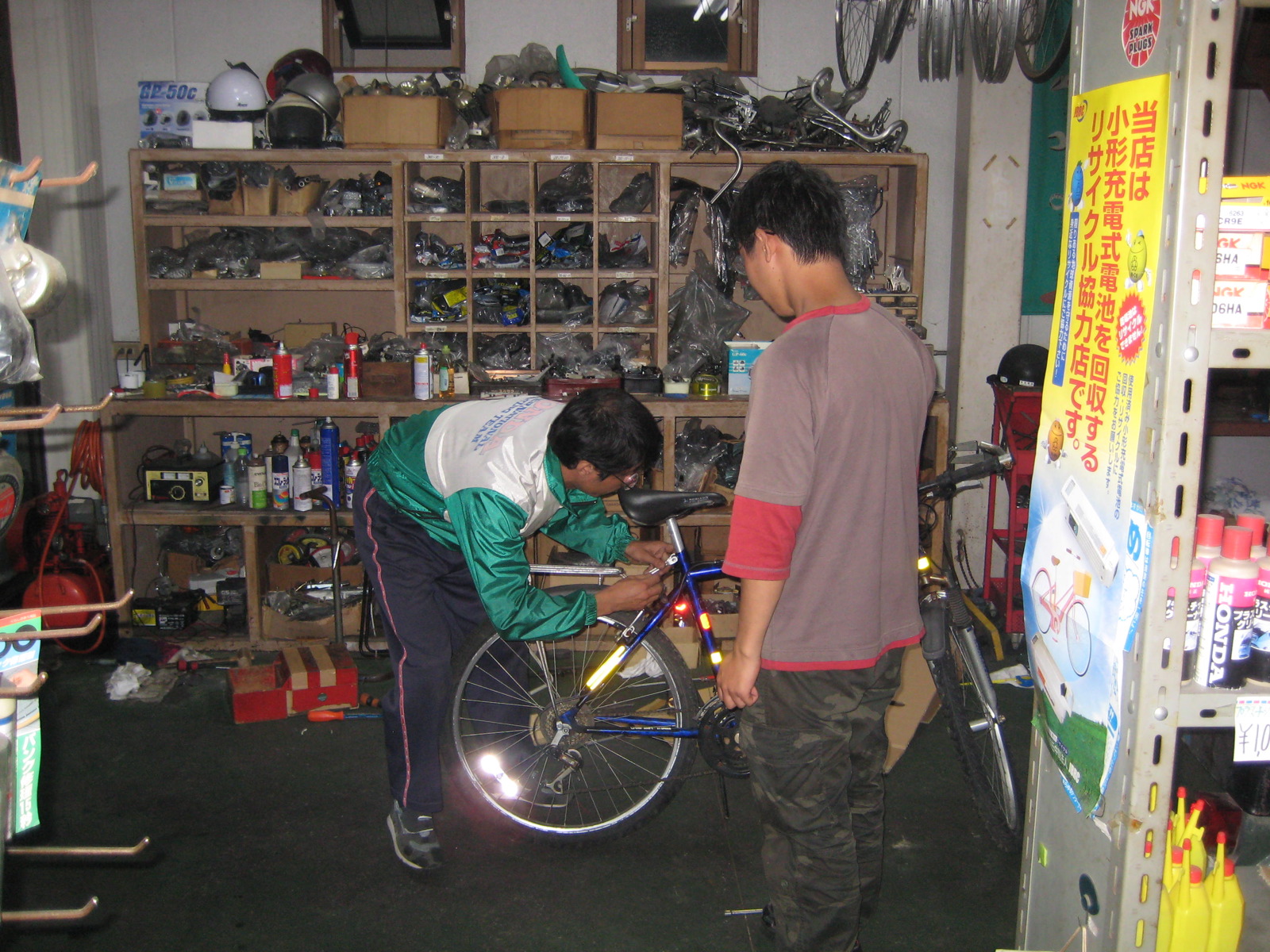
One of Erico’s colleagues drives us to the bicycle-shop in Oumihatiman. On arrival, I see a beautiful blue mountain bike with a far too low saddle (‘Sorry, can’t go up or down, it’s stuck’), no luggage rack (‘but that can be put on’) and only three of the twenty-one gears work (‘but they are the three most important ones’). Erico translates everything patiently and, after a trial run, I am the (un)happy owner of a bike.

My camping equipment was marvellous: the tent was small and light. We put it up in Erico’s flat and that went really fast and easily. However, I wonder how water-tight it is, as there is no inner tent. The sleeping-bag is heavy but therefore nice and warm, but my ‘bed’ is a thin, very thin, insulating mattress.
I must admit: I have little confidence in it all. An unsuitable bike, no bike-bags, so that everything must be tied on the rack at the back, no comfort for the night and, last but not least: the weather will get worse over the next few days, exactly when I had planned my trip round the Biwa-ko lake.
Nevertheless, I feel like it and, with the map on the floor, I make a plan.
Tomorrow I shall cycle round in the vicinity so as to get used to my bike and to riding on the left.
The day after tomorrow (Sunday), I’ll do a real trip. There are other things planned for the Monday and after that I shall cycle round the Biwa-ko lake in three days.
At one point, the Biwa-ko (ko = lake) is very narrow and has a bridge. I work out that I can go round the southern part of the lake in one day and return to Erico’s house. I won’t have to camp the first night. The rest of the lake should be possible in two days. The total circumference of the lake is about 200 kilometres, so, counting the kilometres to and from Erico’s house, it should be about 240/250 kilometres.
I look for camping-sites with Erico on internet. There appears to be a small site on the north shore of the lake, about halfway between two equal day trips. Erico insists on reserving a place for me and for € 3 I am assured of one.
And should I be unlucky: I now have a borrowed mobile phone (mine doesn’t work in Japan) and a train runs right round the lake so, if necessary, I can be home in no time.
My cycling adventure can begin!

