

Tuesday, 21st October, 2008
Distance cycled: ca. 60 km
Weather: sunny and warm, 26˚ C
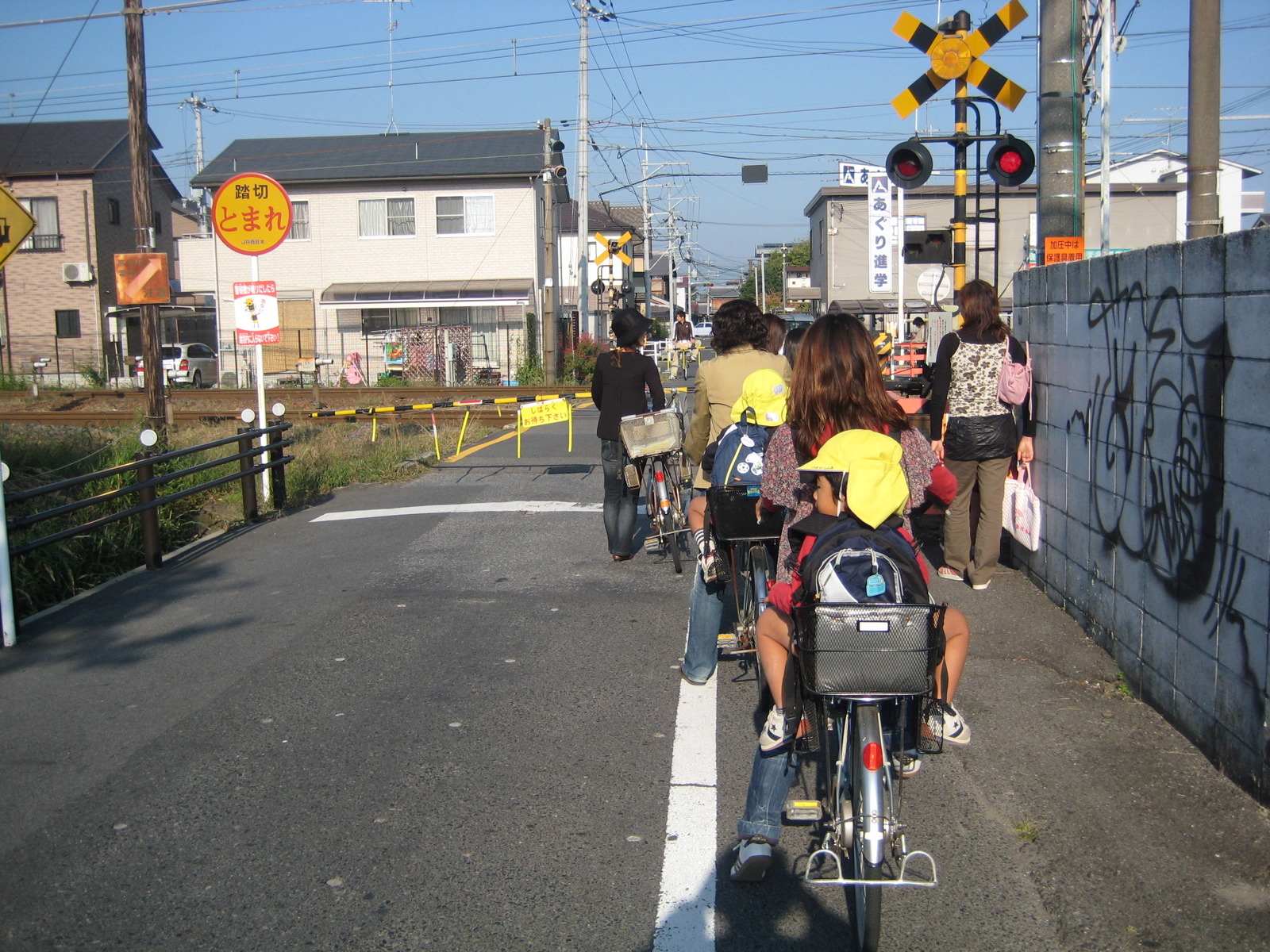
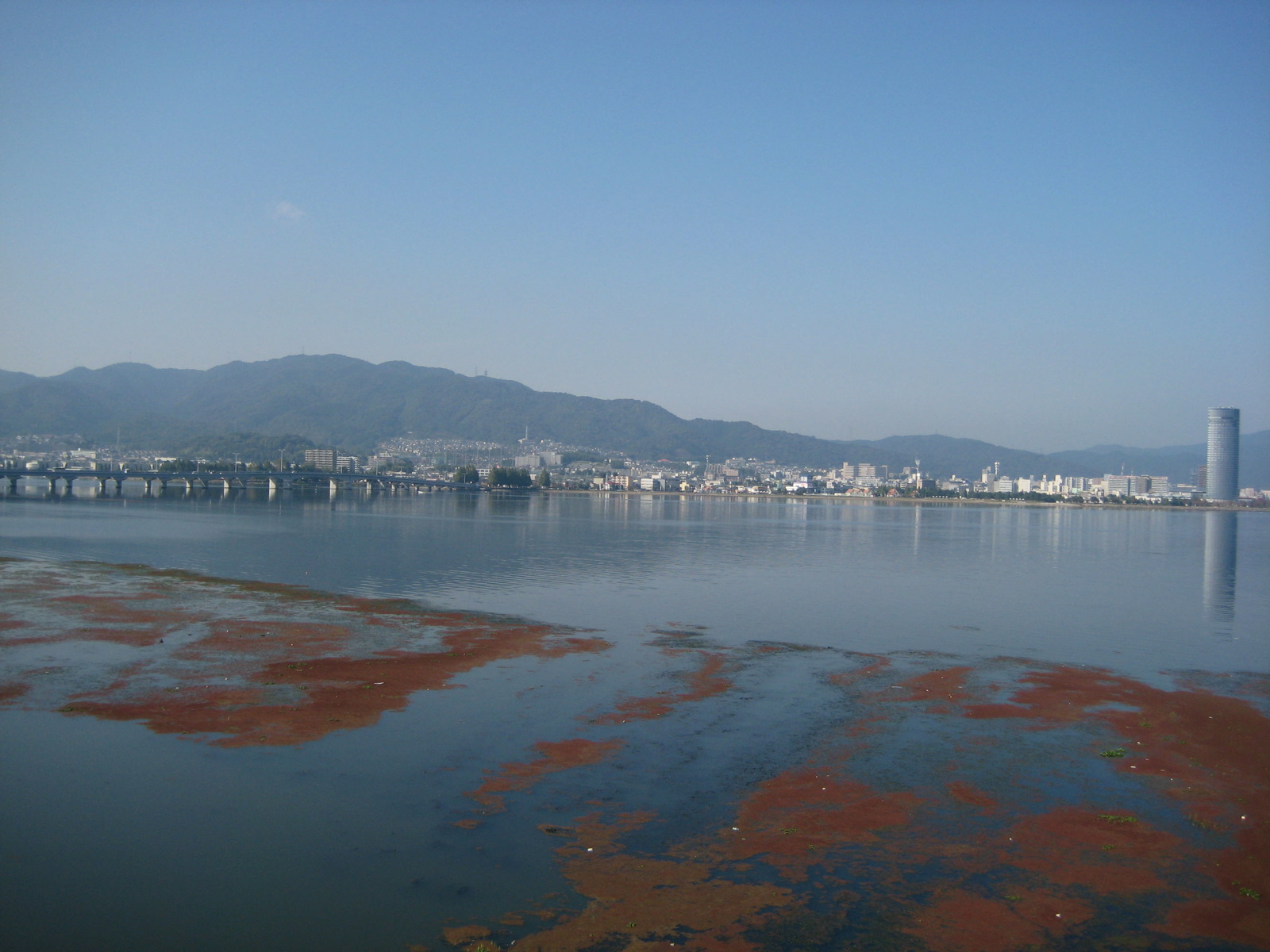
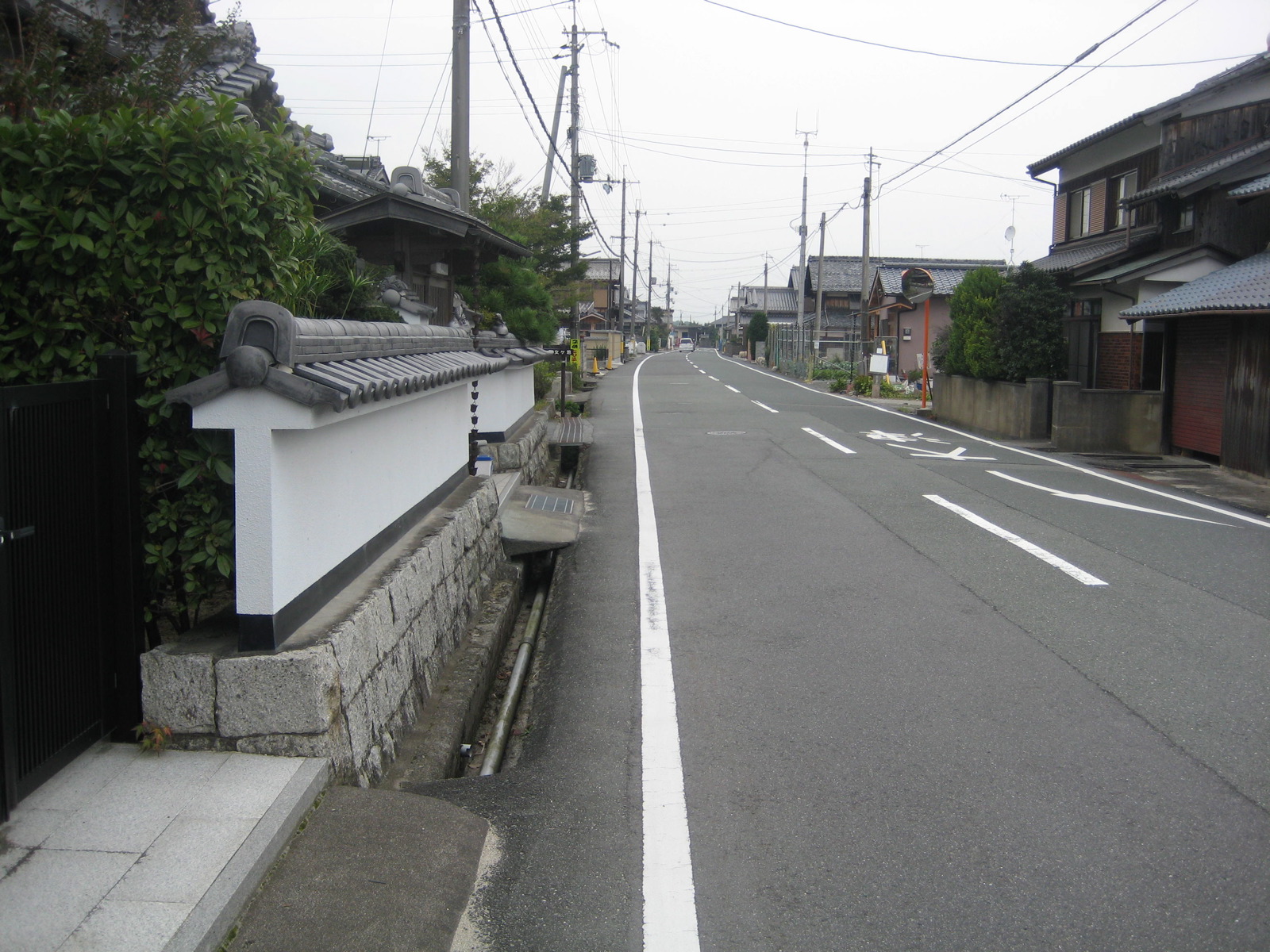
I get away early. Luckily, the weather is still good, though the forecast is different. I have meanwhile got used to cycling on the left and also to the bike. I go the same way to the Biwa-ko as a few days ago and from there southwards, towards the big town of Otsu.
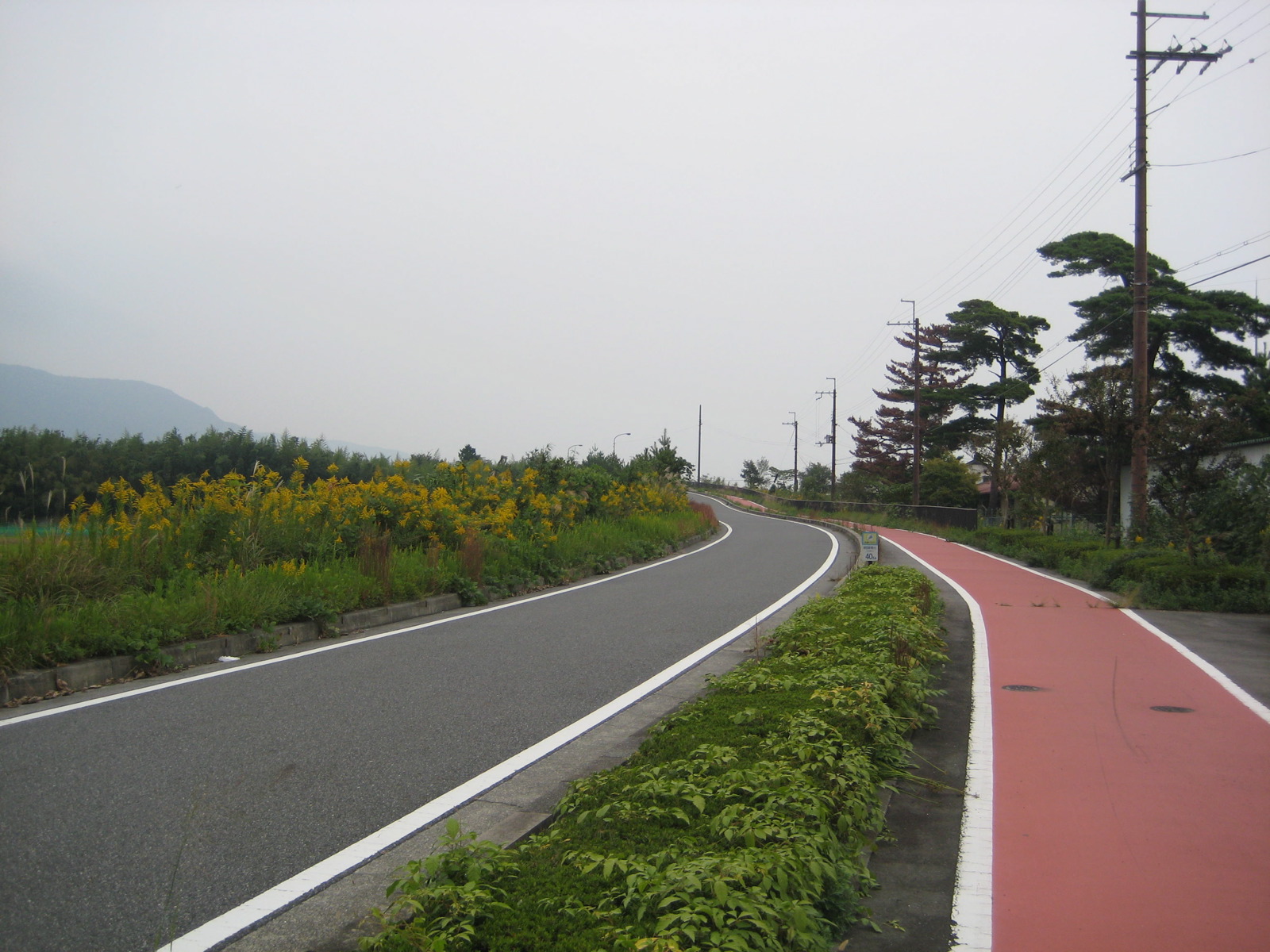
After a few kilometres, I see the first route sign. These are placed every five kilometres, so you know exactly where you are and how much further it is. You can find them on the special bicycle map. It is a very good map, in spite of the fact that I can’t read a single letter.
In one of Otsu’s suburbs, I find a cycle-shop. With no illusions, I hope he sells cycle-bags. It is a small, untidy shop. An old man is working on a bike and comes straight to me. “Soemiemasèn (excuse me), Een-go hanasemaska (do you speak English)?” I had practised this.
“Ie-è, ie-è (no, no)”
I get my booklet ‘How to say it in Japanese’ and look for the word bag.
“Kaban?” I ask.
To my surprise, he understands. He points to the bike and the carrier. I nod eagerly. Yes, exactly. But no, he has no bag. Ericao had already told me that she didn’t know whether cycle bags were to be had in Japan at all. But being pigheaded, Gea had to check this herself. Meanwhile, his wife has also come into the shop. She points to some black metal baskets for the handlebars but these don’t fit on my bike. Neither are they really handy, everything on the handlebars, it would be more trouble than an improvement.
Then I see a bidon. Ah, I need one of those and I have a holder, after all. At the moment, I have two bottles in my bag but a bidon makes life a lot easier. I am about to go away when the woman calls and points. I’ve no idea what she means but she takes the bidon from me and goes to the back of the shop. Then she comes back with the bidon, filled with water.
Waved off by two nice old people, I go outside, put the bidon in its holder and unlock my bike. Then I see the man and the woman standing at the window, in front of which my bike is standing. They look curiously at my bike. The laugh and nod encouragingly to me. Waving, I cycle on.



Wednesday, 22nd October, 2008
Distance cycled: ca. 75 km
Weather: cool, cloudy, rain later in the day, rain and storm at night
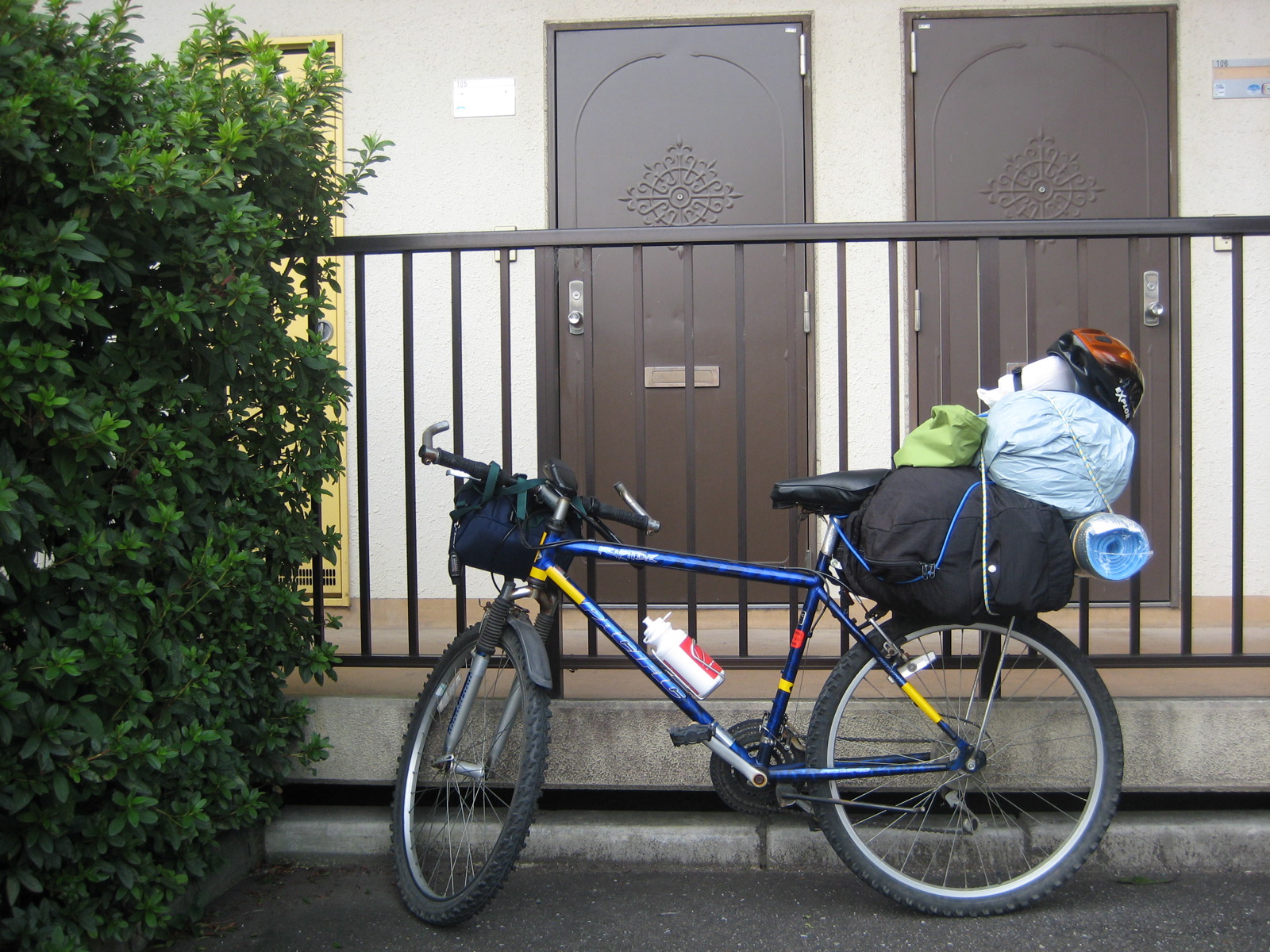
Right, I’m ready. I have borrowed a large bag from Erico in which to put all my stuff. Everything is wrapped in plastic as it looks as if it’s going to rain for the next two days.
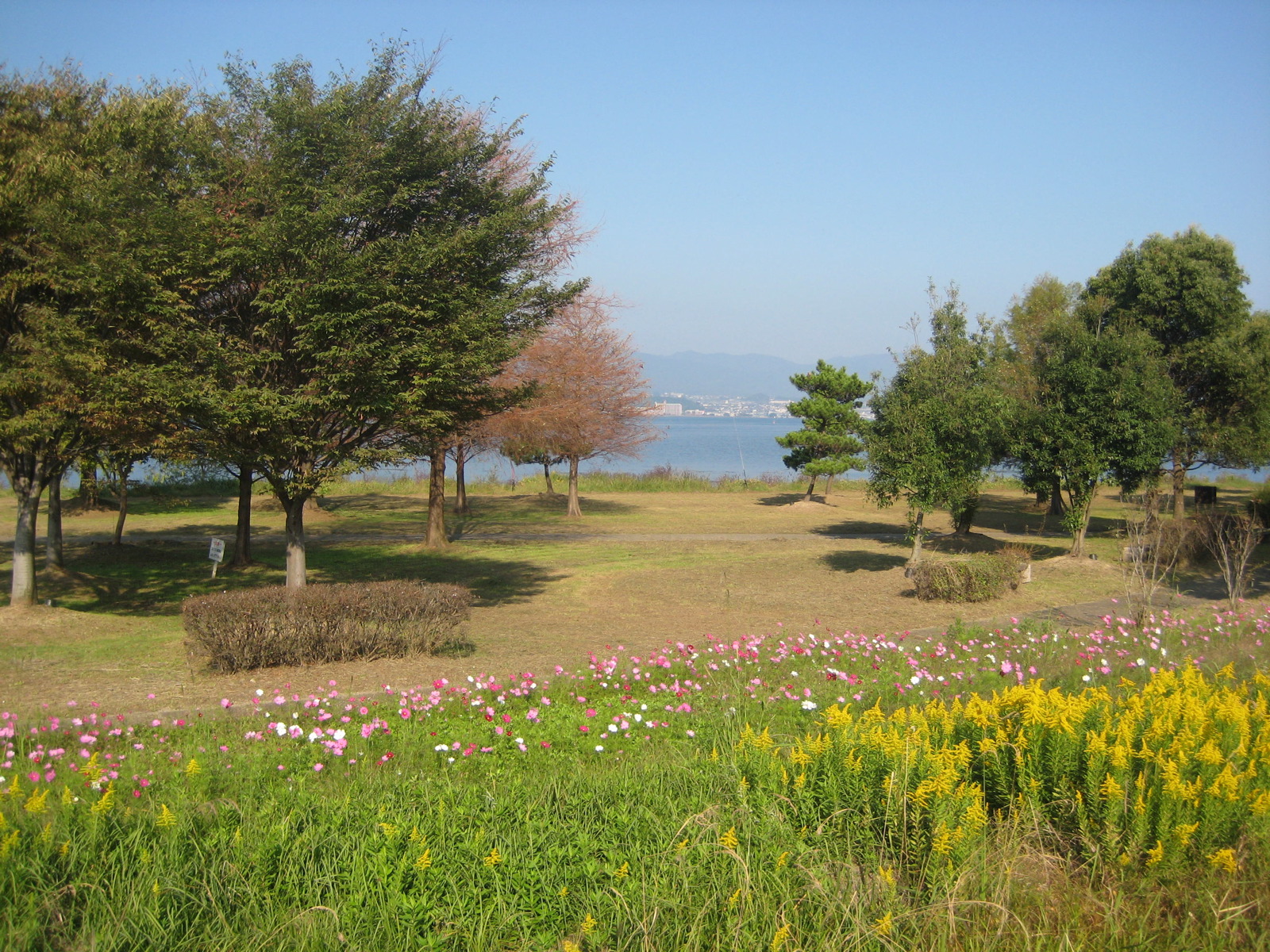
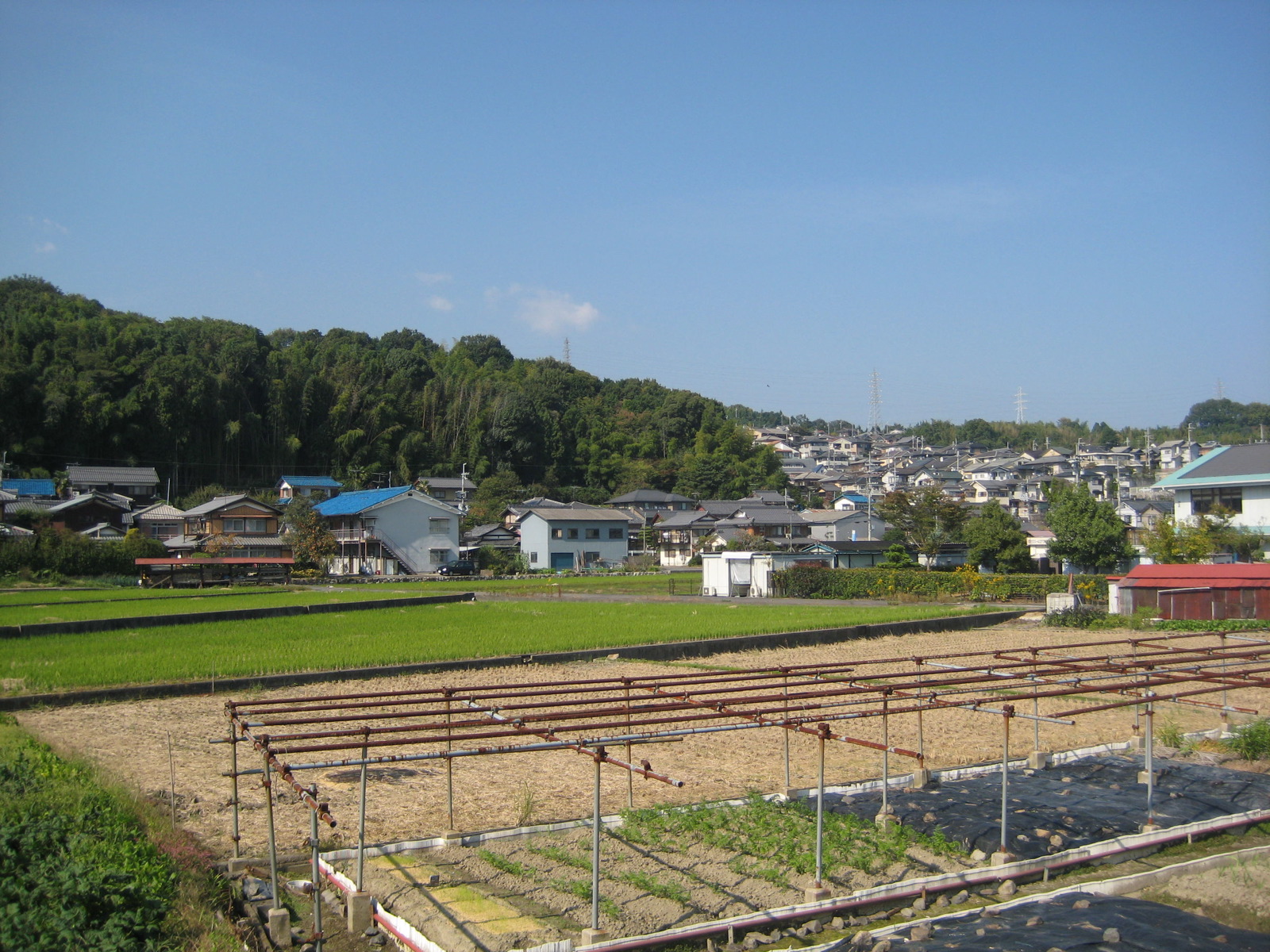
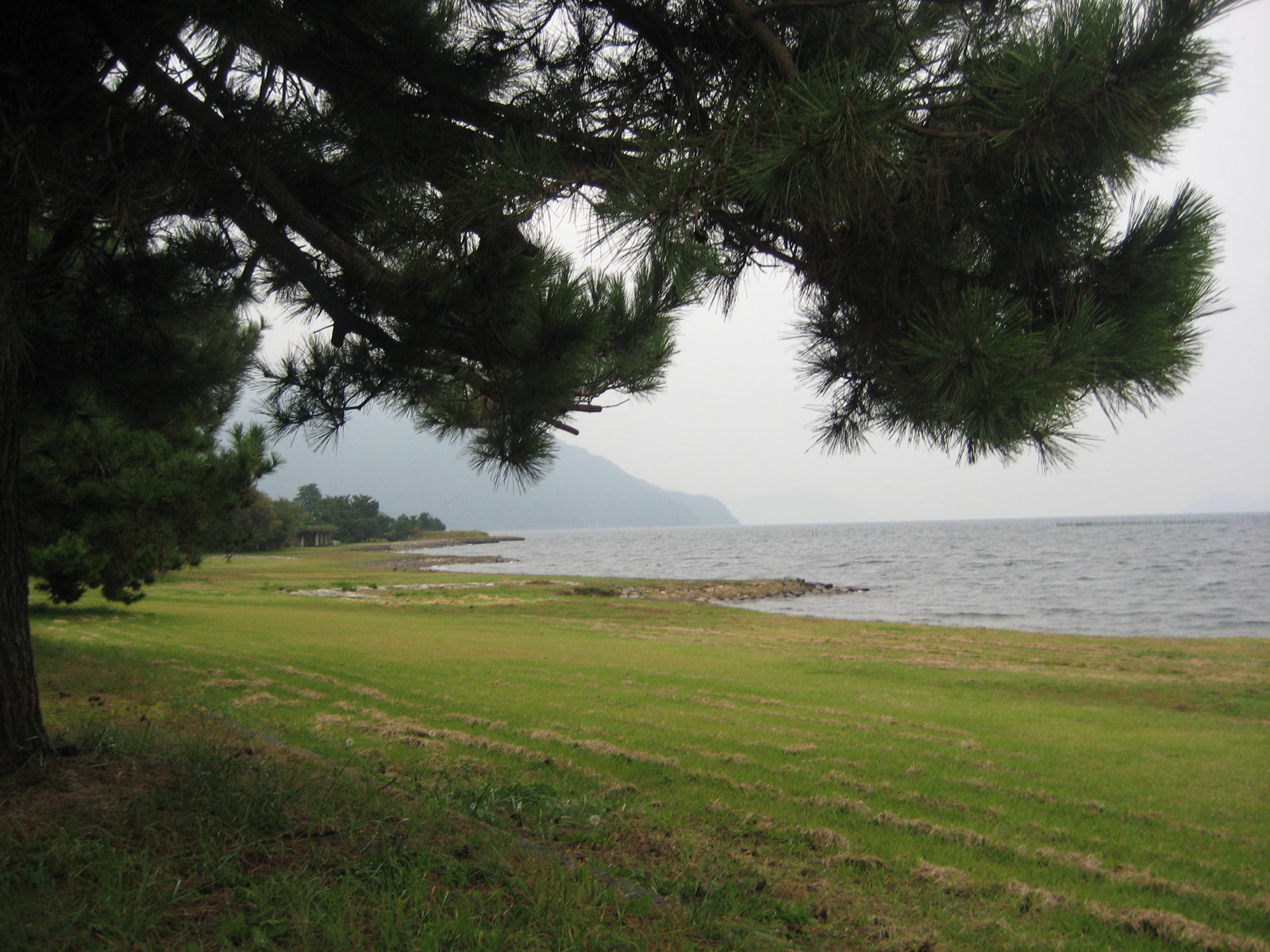
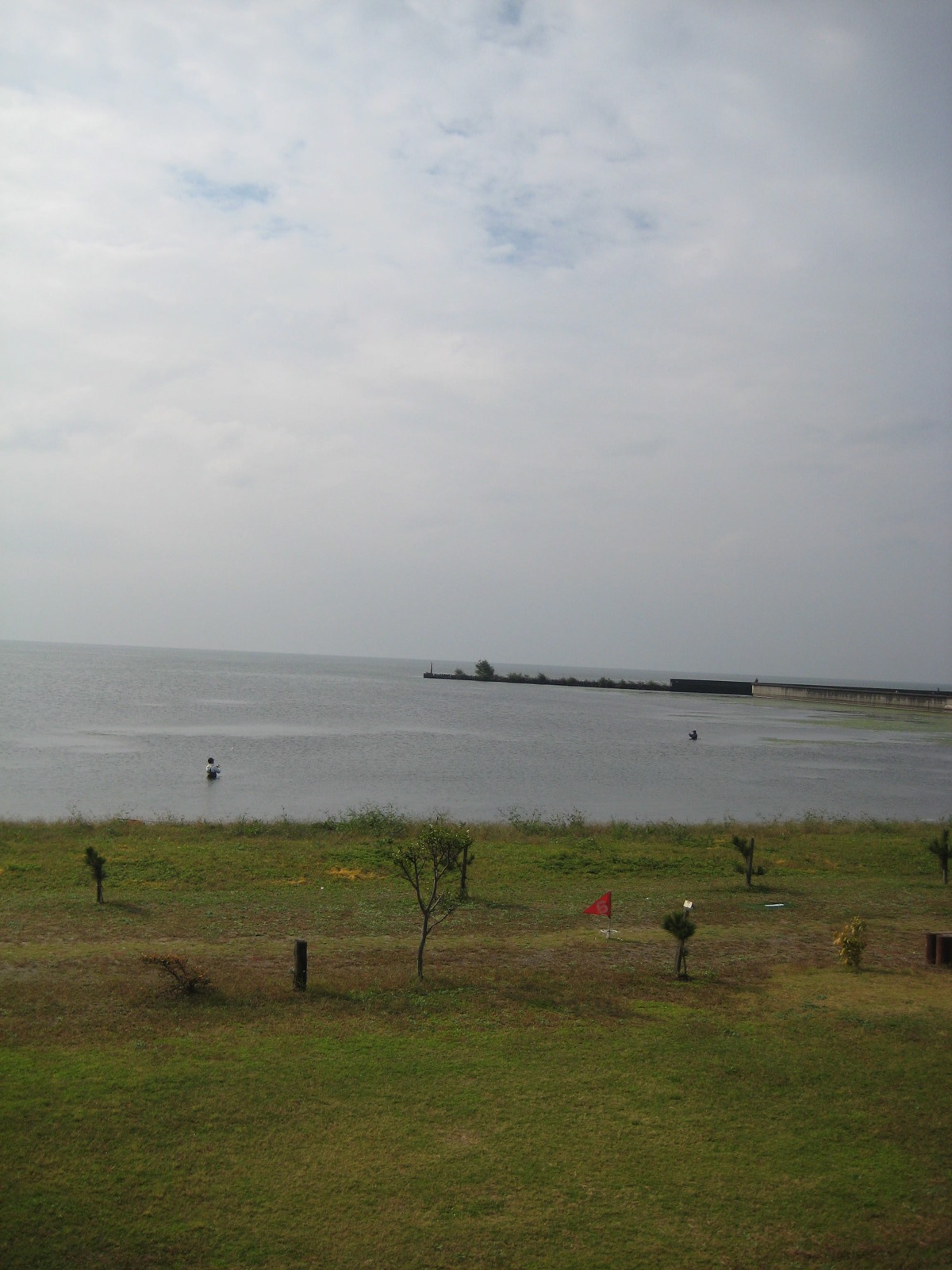
II take the same route to the lake and then north to get to the other side of the lake.
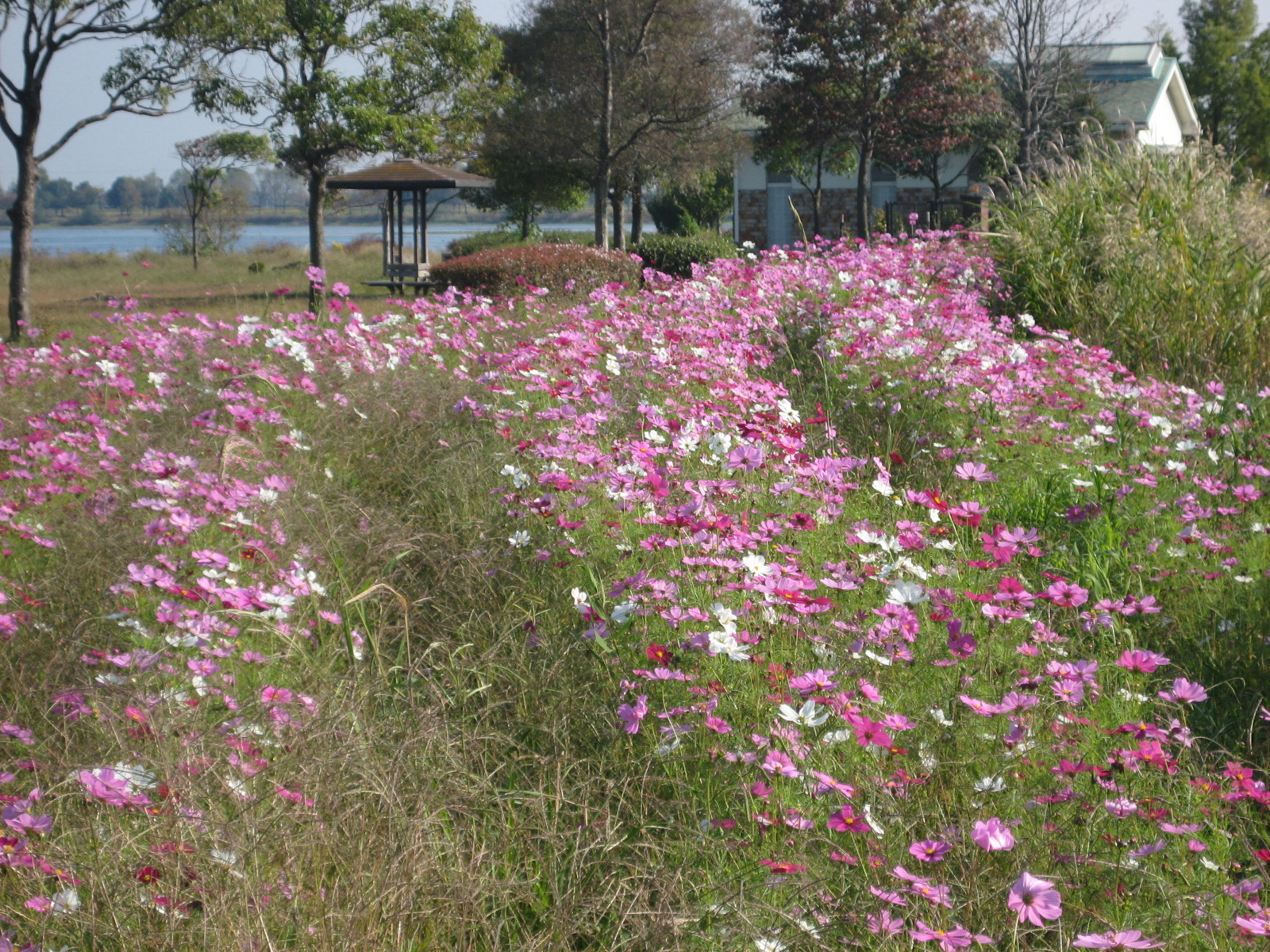
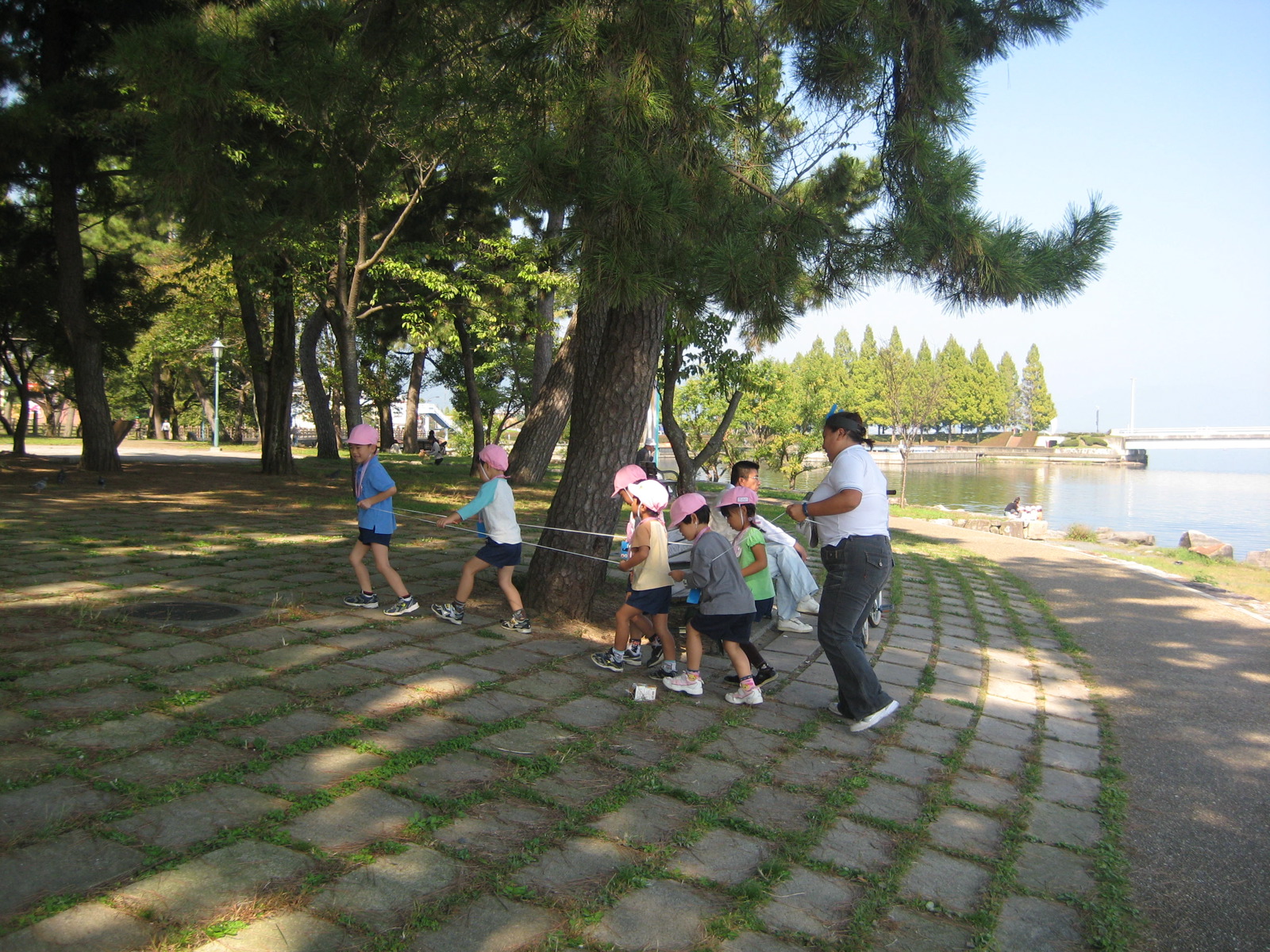
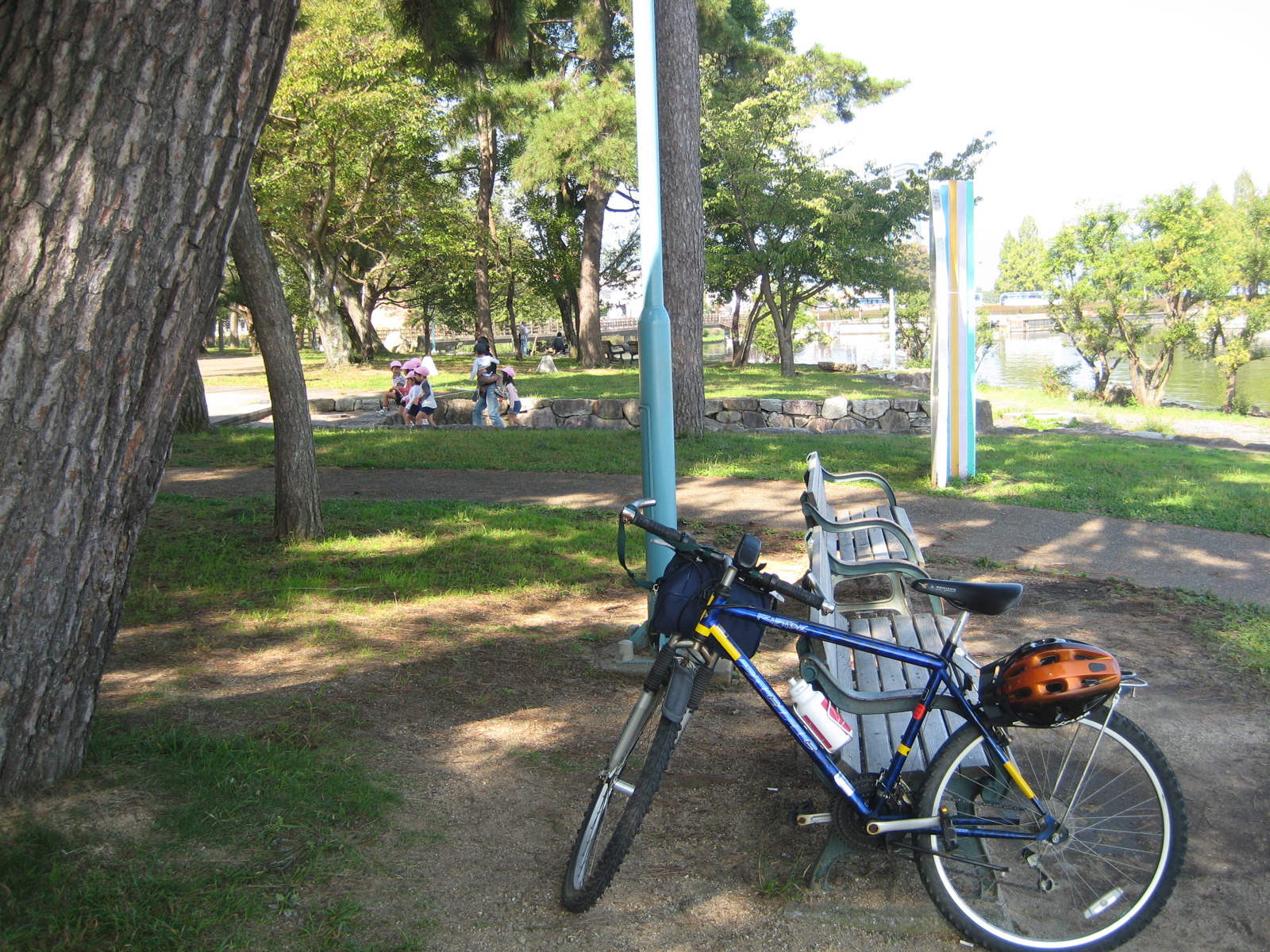
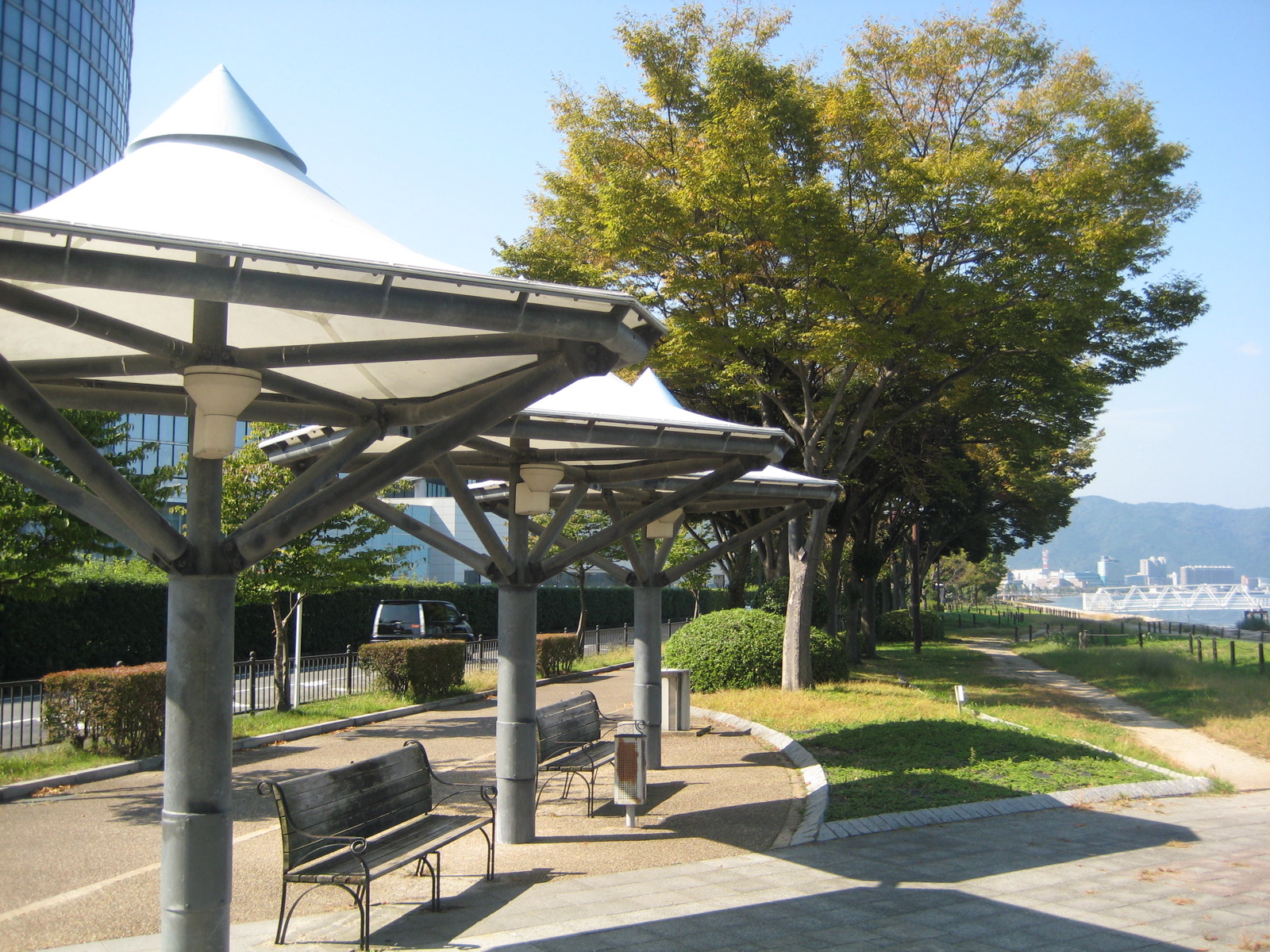
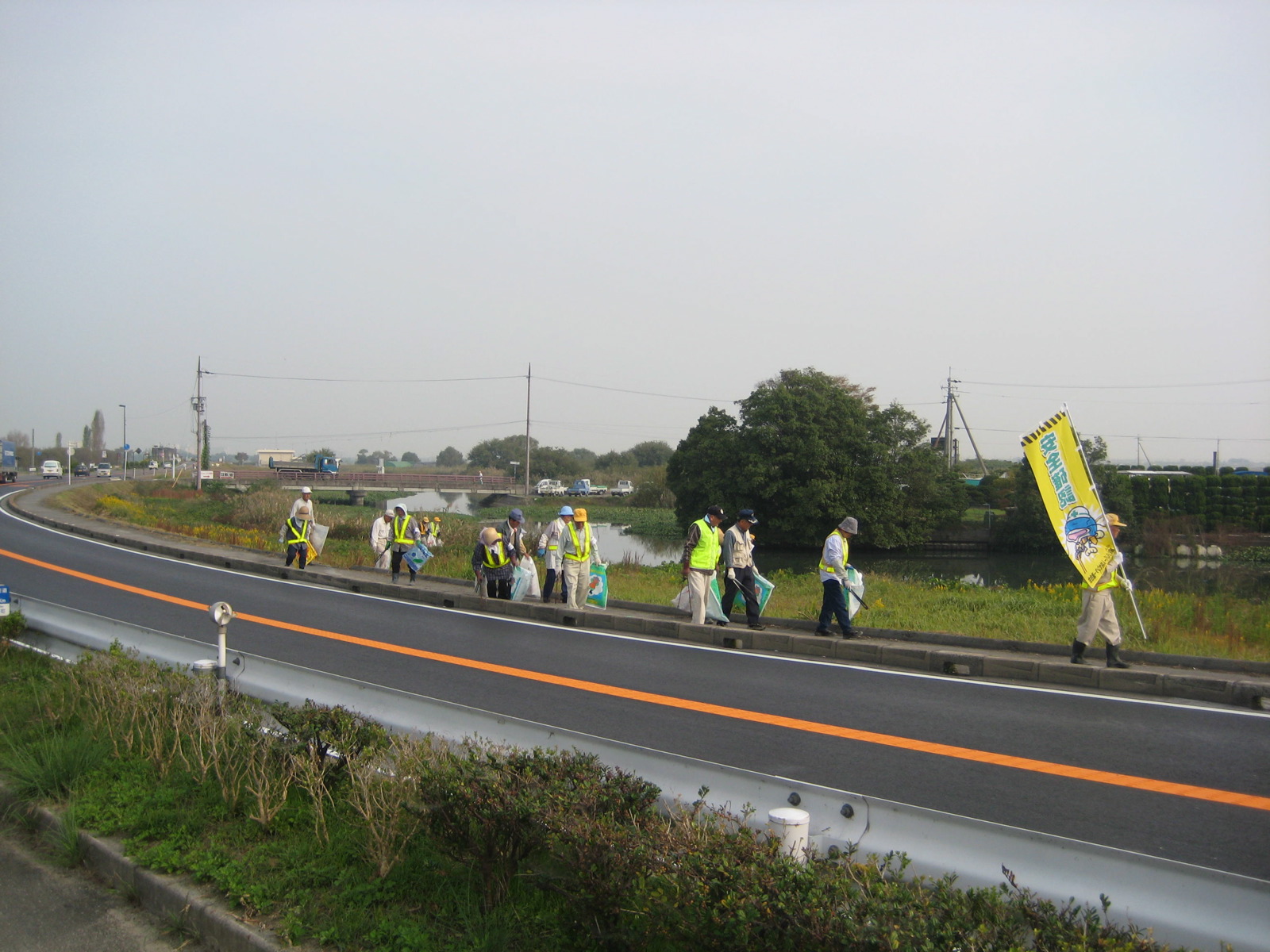
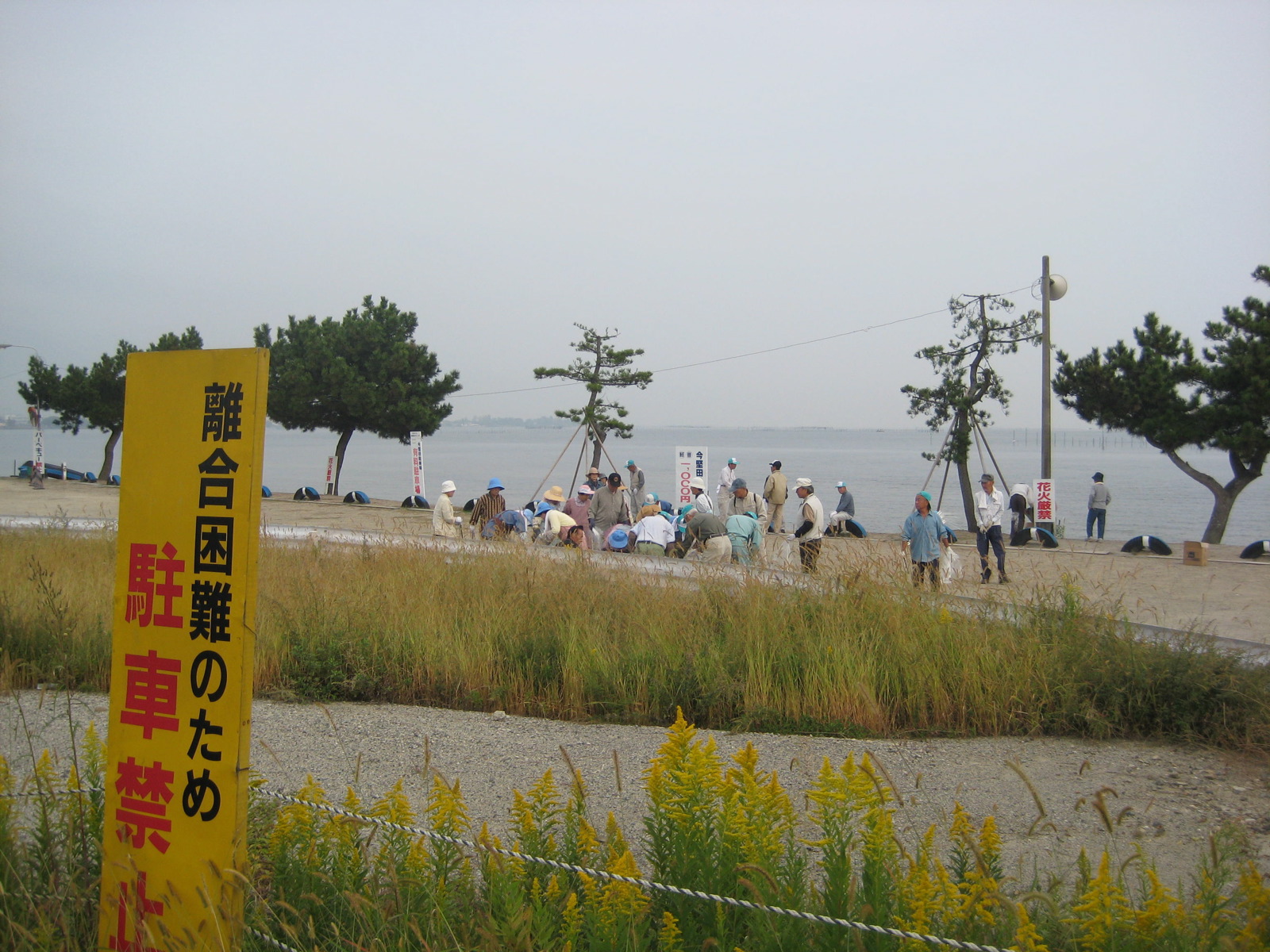
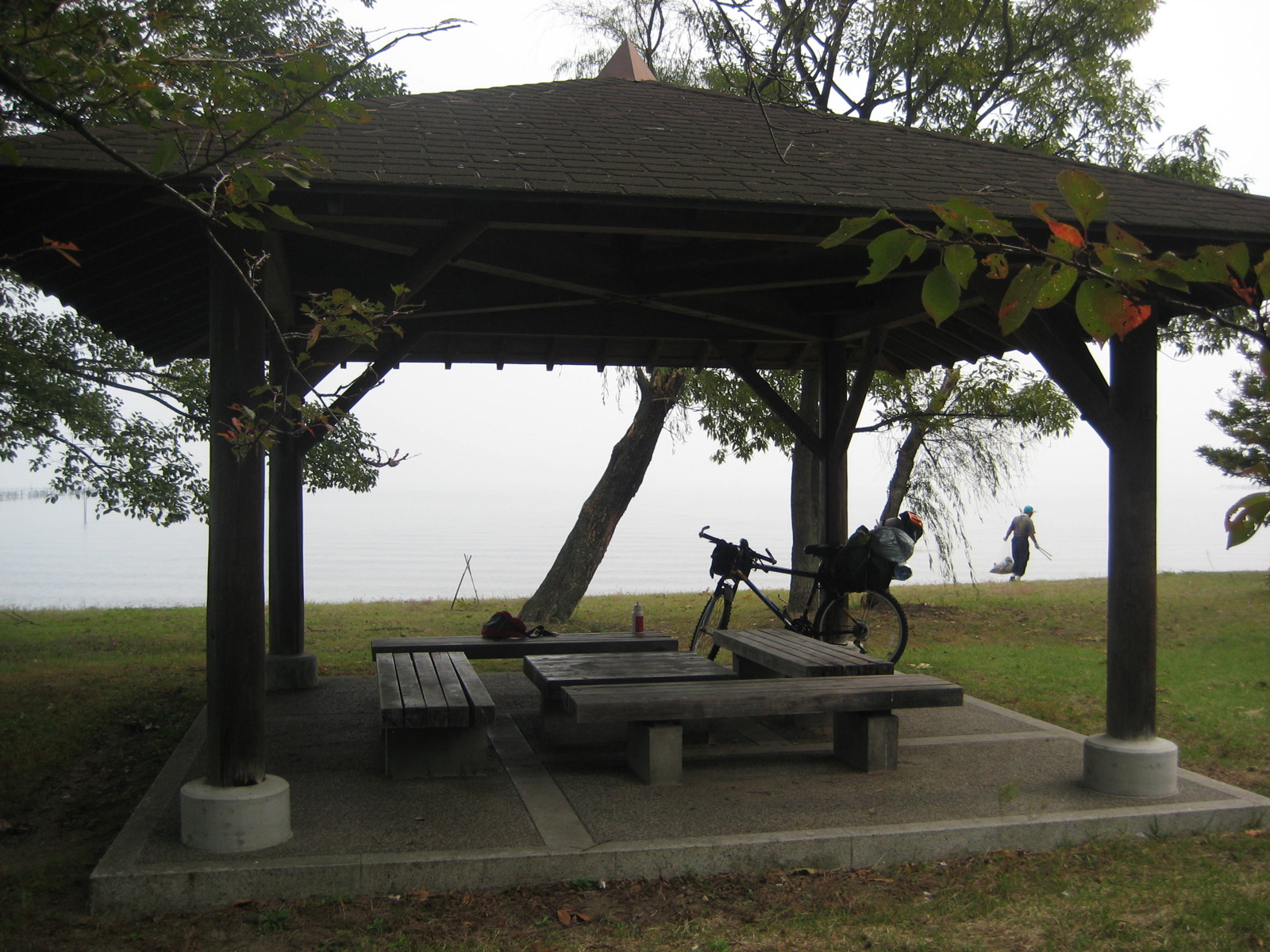
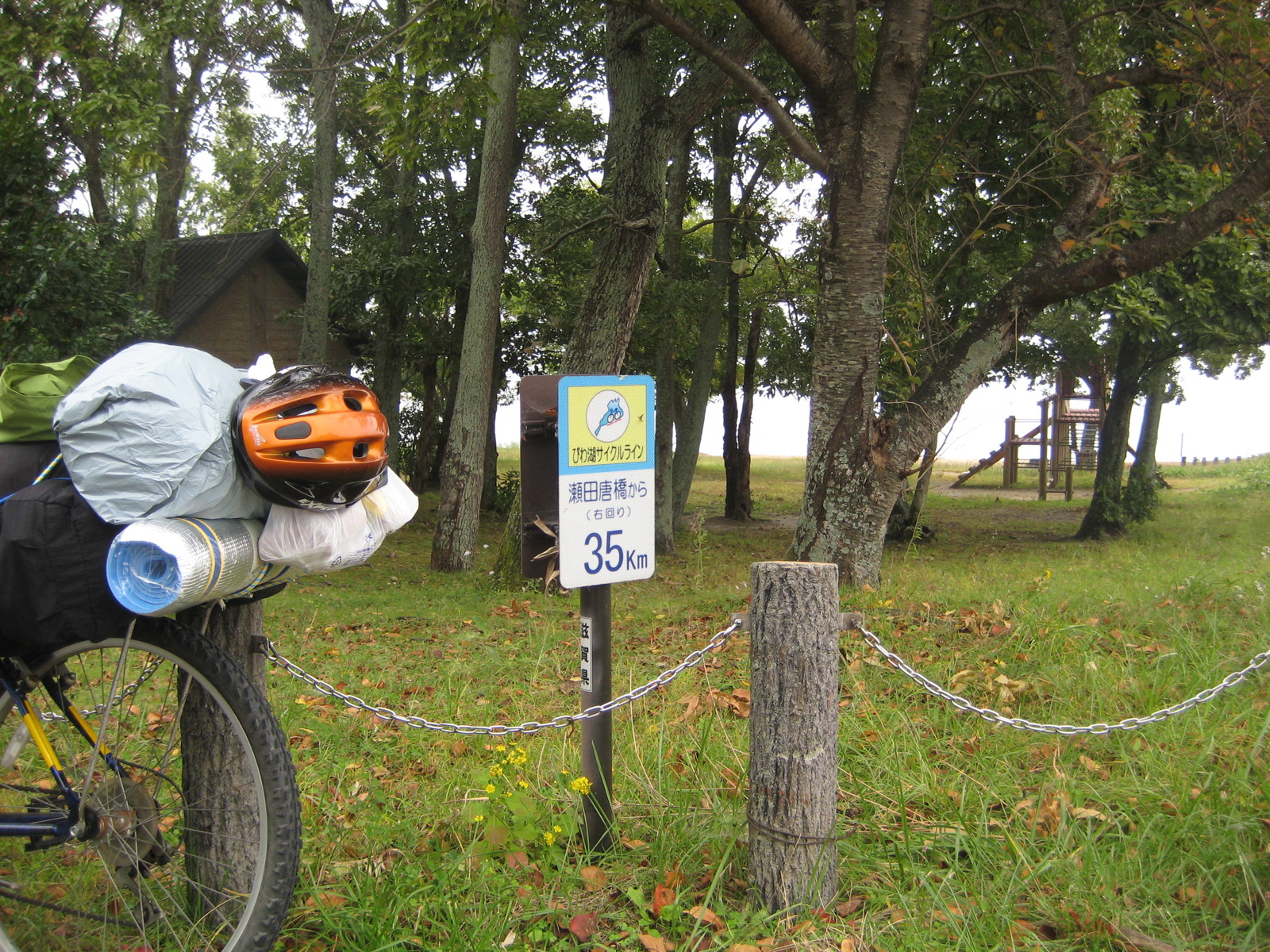
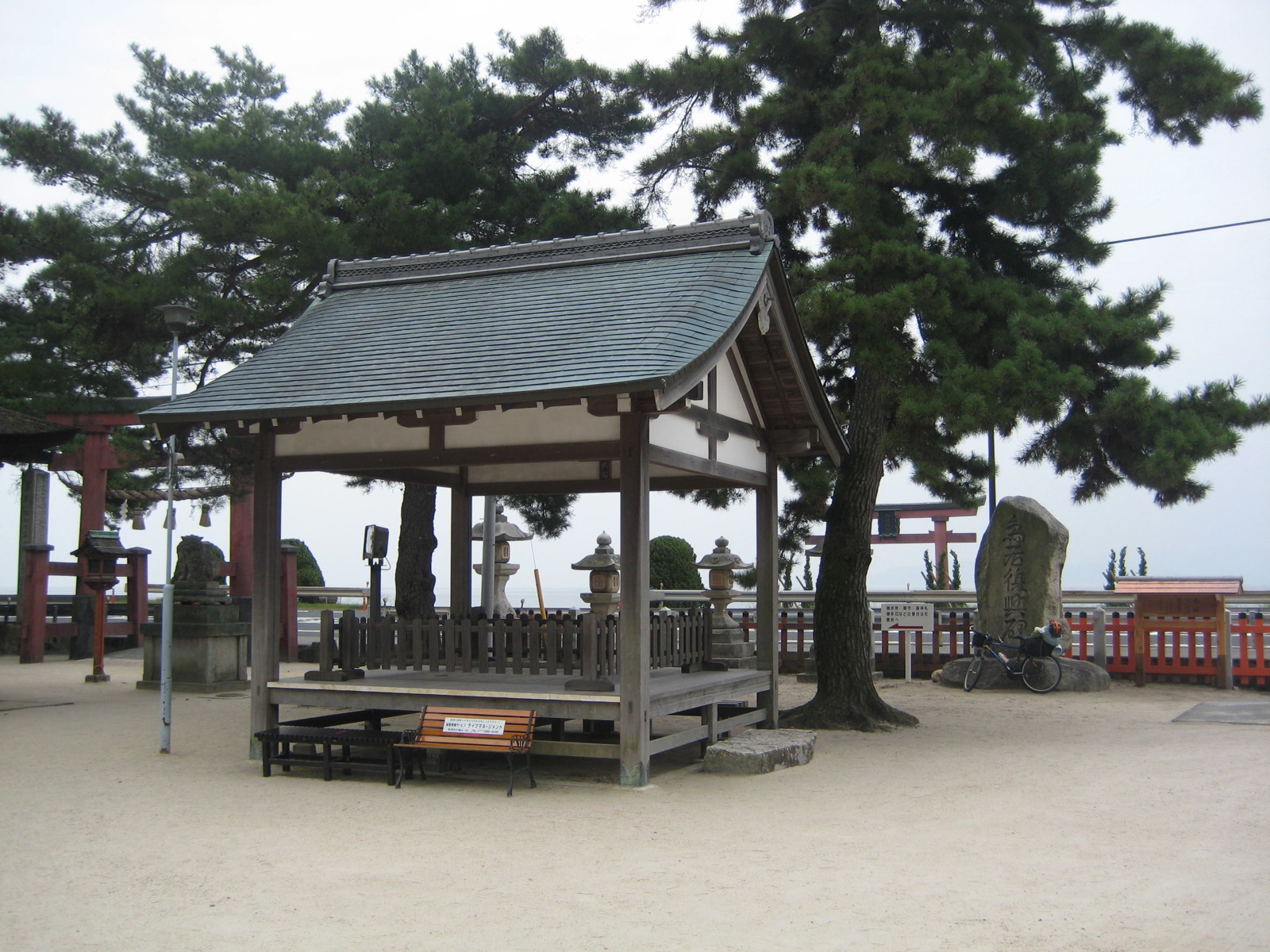
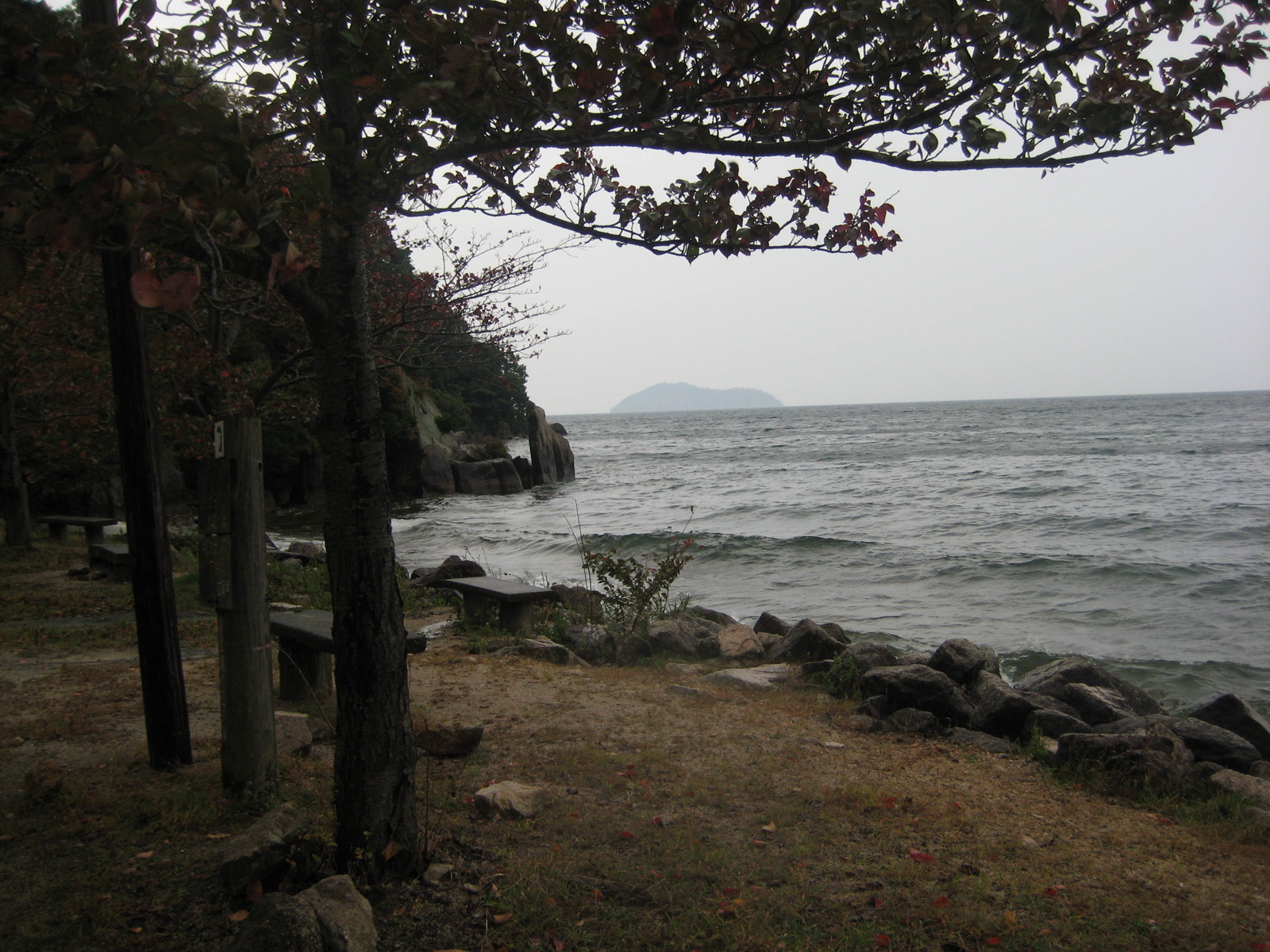
At the picnic spot on the photo above, I make a short pause. I have just sat down when four of the cleaners come and stand round my bike. They feel, knock and admire and I hear sounds of ‘Ie, Aa, Oo’. When they see the map on my bag, a discussion starts. Four different spots are pointed to on the map and, if I may be so bold: at the moment we are not on any of them. I point to the right spot and the men nod admiringly. Politely (?) they do not contradict me. They ask a lot of questions but I don’t understand anything. I nod a bit and say ‘Hai (= yes); that’s what the Japanese do if they don’t understand something. I decide to make an end to this Babylonian confusion of tongues by making it clear that I want to go on. One of them says “Goodbye” and the others seem to think this funny and laugh at him. But as I ride away, they all call “Goodbye”.
I watch for a bit, unnoticed. At least, I think so. When I get on the bike again after five minutes, about ten people wave goodbye.




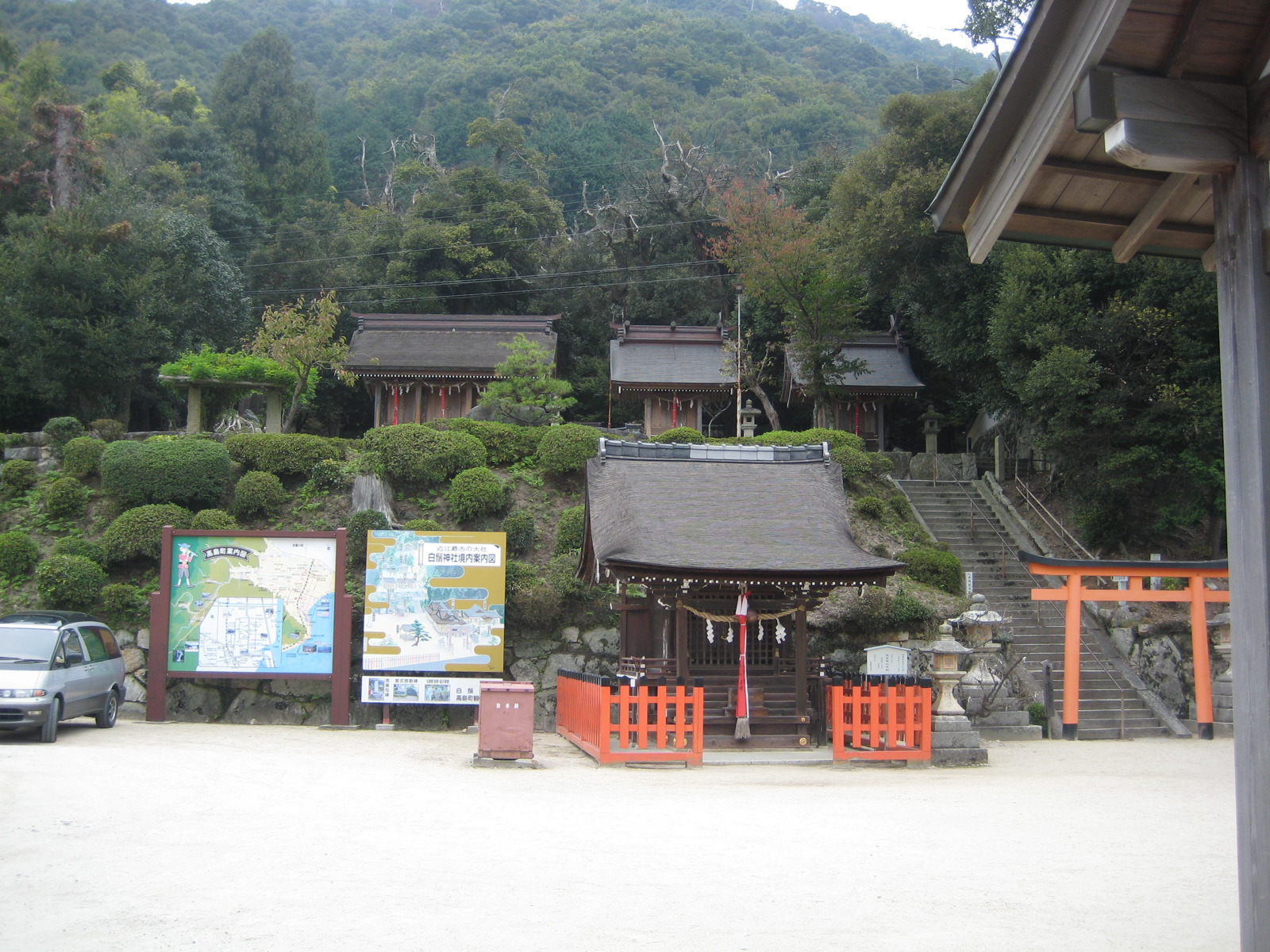
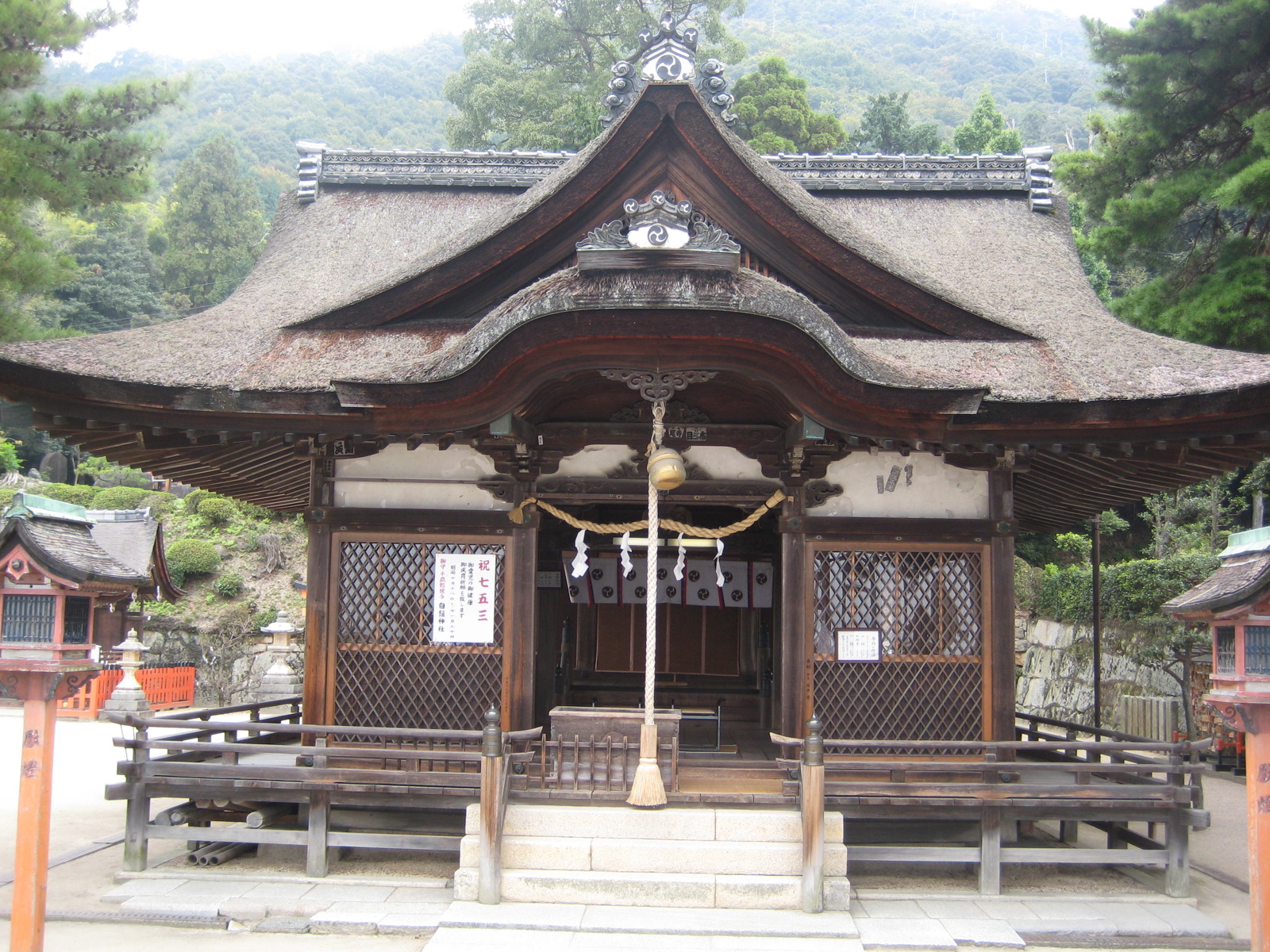
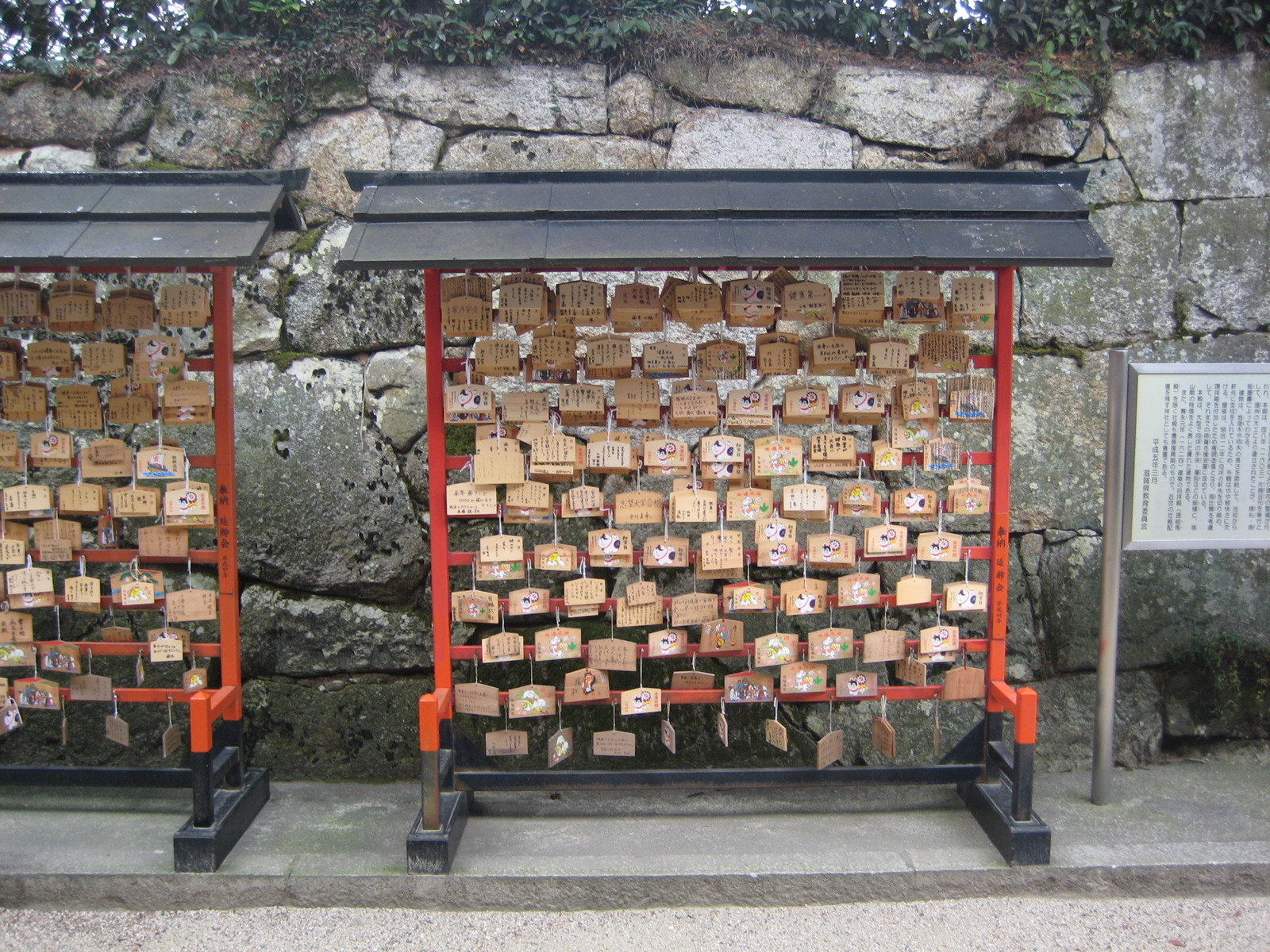
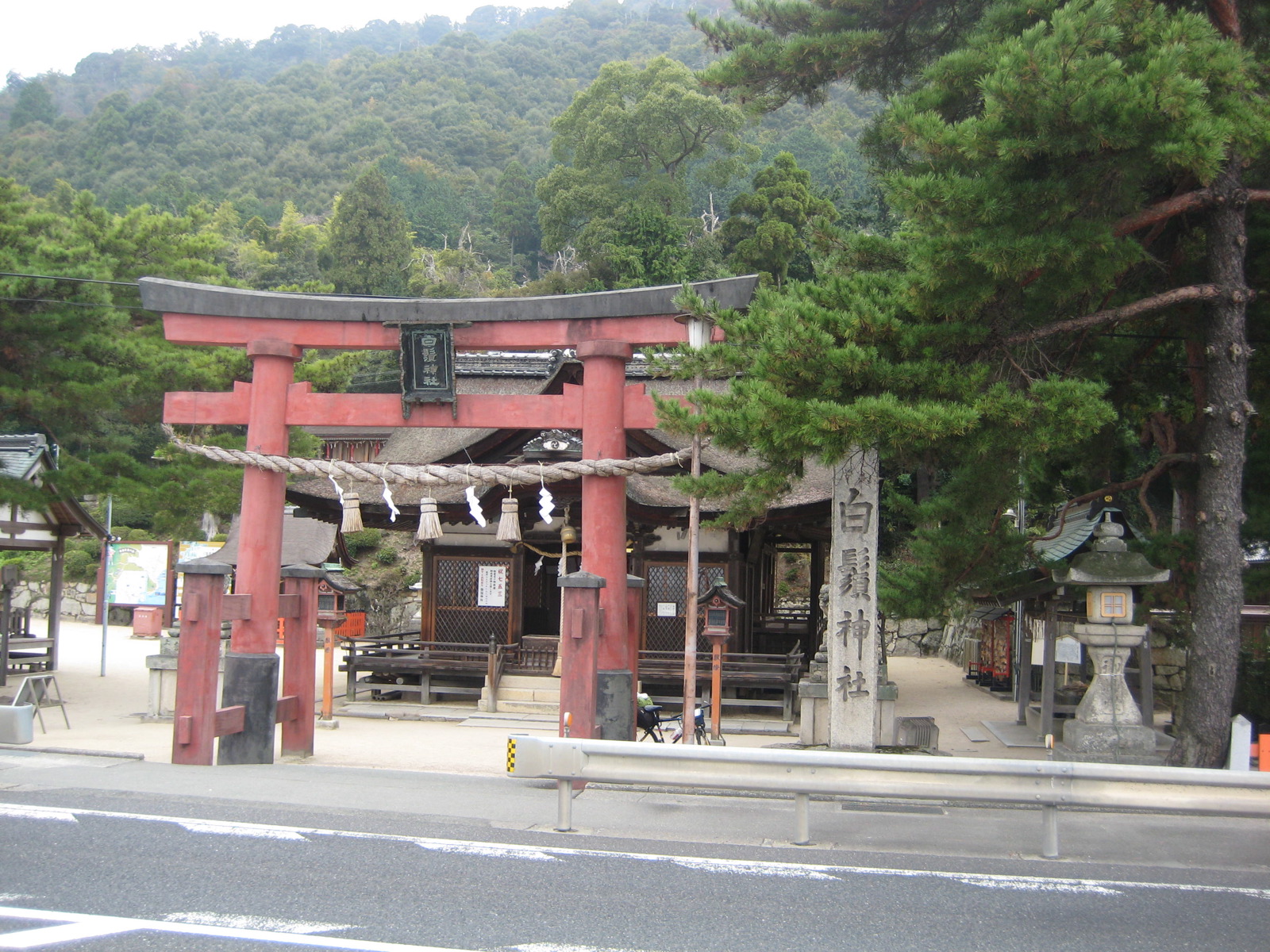
Near Takashima is the Shirahige Jinja Shrine, right next to the road, and I visit it. I’ve learnt a lot in a few days and wash my hands before going any further. A man nods approvingly at me and asks, “Americano?”
“Ollanda”, I answer.
“Ah ... Orranda”, says the man admiringly and then sees my bike.
“Your bike?”
Surprised by his English, I confirm this.
“Do you speak English?”, I ask.
“Little”, and he puts his thumb and first finger close together.
He begins to talk and, if I have understood correctly, he is a sort of guide to the shrine. Then I get a lot of questions and tell him enthusiastically what I am doing, pointing to places on the map. And then I make a big mistake: on the map, I point to the camp-site where I am going to spend the night. Just as my finger points to the spot, I realise, pretend to doubt and point a little further on the route. Then I say, ‘somewhere there’ and point to the whole northern shore.
“Are you going camping??? Alone??? That is much too dangerous in Japan. You really shouldn’t!”
Well, my only worry at the moment is that he knows where I am going to camp, as I have marked the place with a circle on the map. And although Japan may be safe enough, this is almost like ‘presenting yourself’. The man doesn’t seem at all dangerous to me, but that means nothing.
“Maybe I’ll change my plans if you say it is so dangerous. I’ll find a hotel”.
The man immediately offers to help look for one but I decline his offer pleasantly, saying,
“I still have all afternoon, I’m sure I’ll find something”.
The man looks worried but offers to show me the temple complex. I say that I want to take a few photos but must then go on quickly. That was that. Somewhat worried, I cycle on. On the map, I had seen that there were two other camp-sites near the reserved one, a little before. I’ll have a look at them.
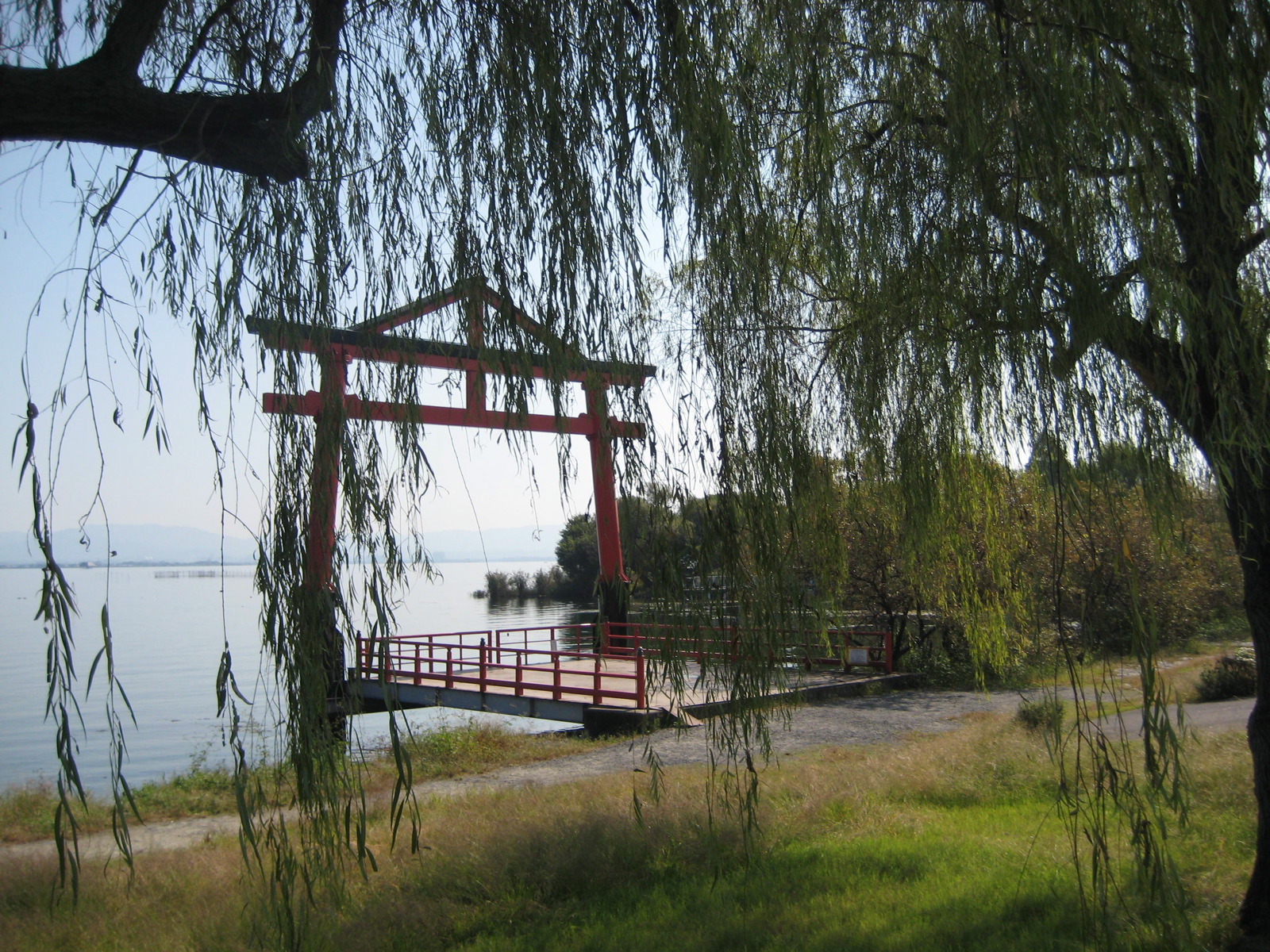
As I already mentioned: if you want to go to a shrine, you have to go through a gateway. There are toriis at every entrance: coming from the mountain, from the road or from the water. This can be clearly seen on the photo.
The route is signed but often the signs are missing when you need them. The route is not so difficult, so long as you make sure the lake is on your right. However, I was glad I had my compass with me.
Of the two camp sites on my map, one doesn’t exist (at least, it can’t be found) and the other is closed. I decide to stick to my original plan after all.
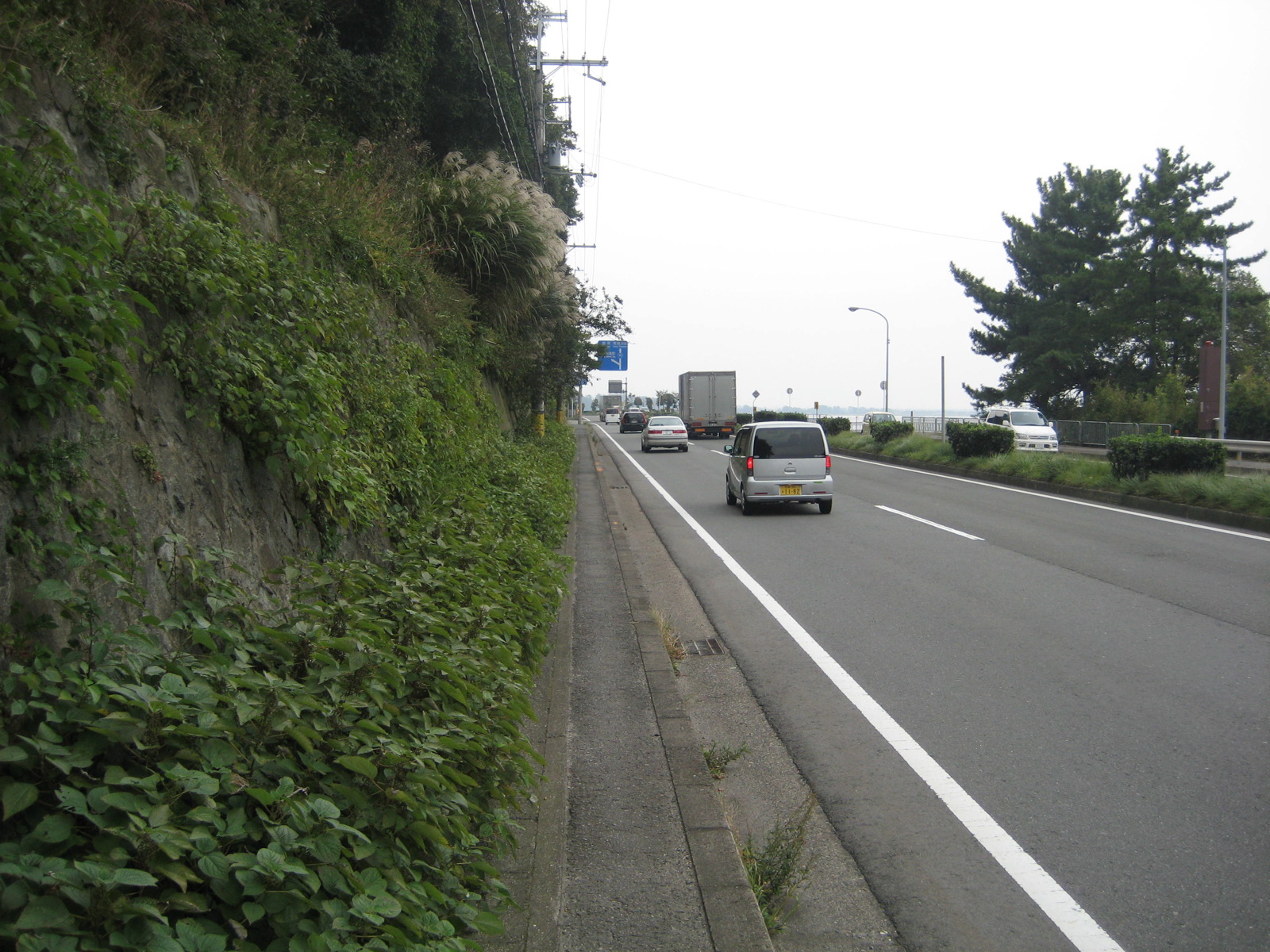
Before I get to the camp-site, I have to go through some tunnels. I don’t like doing that, although they are not so long. Even fairly short, according to Japanese ideas. I had already read about the many (long) tunnels in Japan but here, round the Biwa-ko, it’s not too bad up to now.
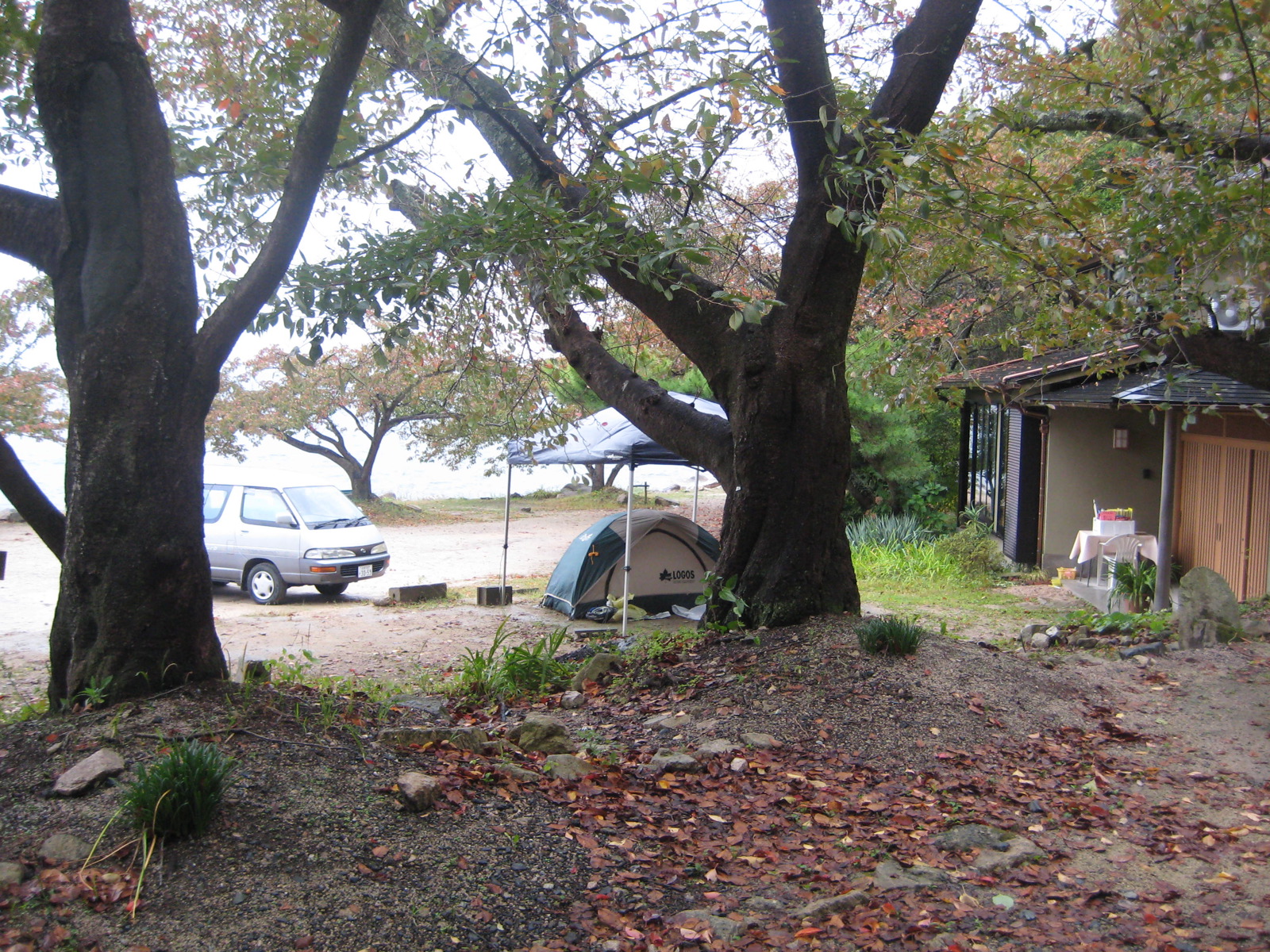
I get to the place where, according to the map, the site should be. To get the picture: the road wriggles through the rocks (therefore the tunnels), then to the right, an open area appears, about 40 to 50 metres between the road and the lake. There is a house there, something that looks like a parking lot and a shed. The rest is beach. Is this really the camp-site? There is nothing there, no caravan, no tent. But then I have no idea what Japanese camping sites look like. I knock at the door of the house but get no reaction.
A car comes along. It reduces its speed, stops for a moment and then drives onto the area. When I see who gets out, I get a fright: it ‘s the same man I met earlier today at the temple. Whom I told where I was going to camp. He apologises and I gather from his story that he was worried about me. He is probably telling the truth (worrying is typically Japanese), but he didn’t have to come, as far as I’m concerned. He looks round.
“Camping?” he asks.
“Yes, I think so”.
“Have you spoken to the owner yet?” And he points to the house.
“Not yet.” I don’t tell him that I had already knocked at the door and that I think there is no-one at home.
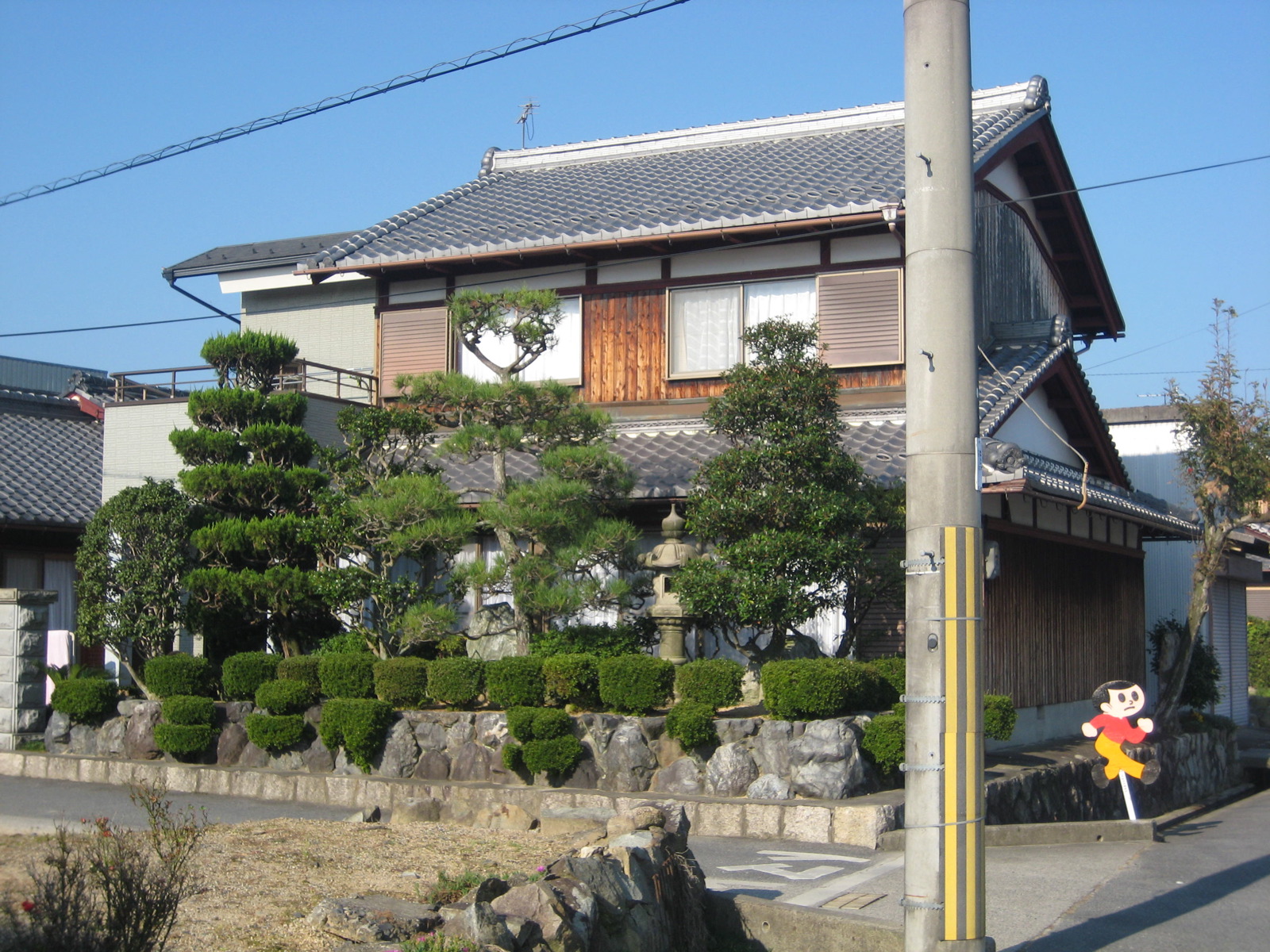
A small digression about Japanese houses. Chiaki once told me that when she came to Holland, she had looked at the houses in amazement: there you can see right through the windows to the inside! In Japan, there are shutters in front of the windows. These are, in fact, always closed, except if you can’t look in. At dusk, at the end of the afternoon, all the shutters are closed and there is not a chink to let light through. So an unsuspecting person from the Netherlands comes to the conclusion: there is nobody at home.
The man goes to the house, opens the door and walks in. A little later, he comes out with a woman. She doesn’t speak a word of English so the man acts as interpreter. The woman had already expected me, welcomes me and says I may stand wherever I like.
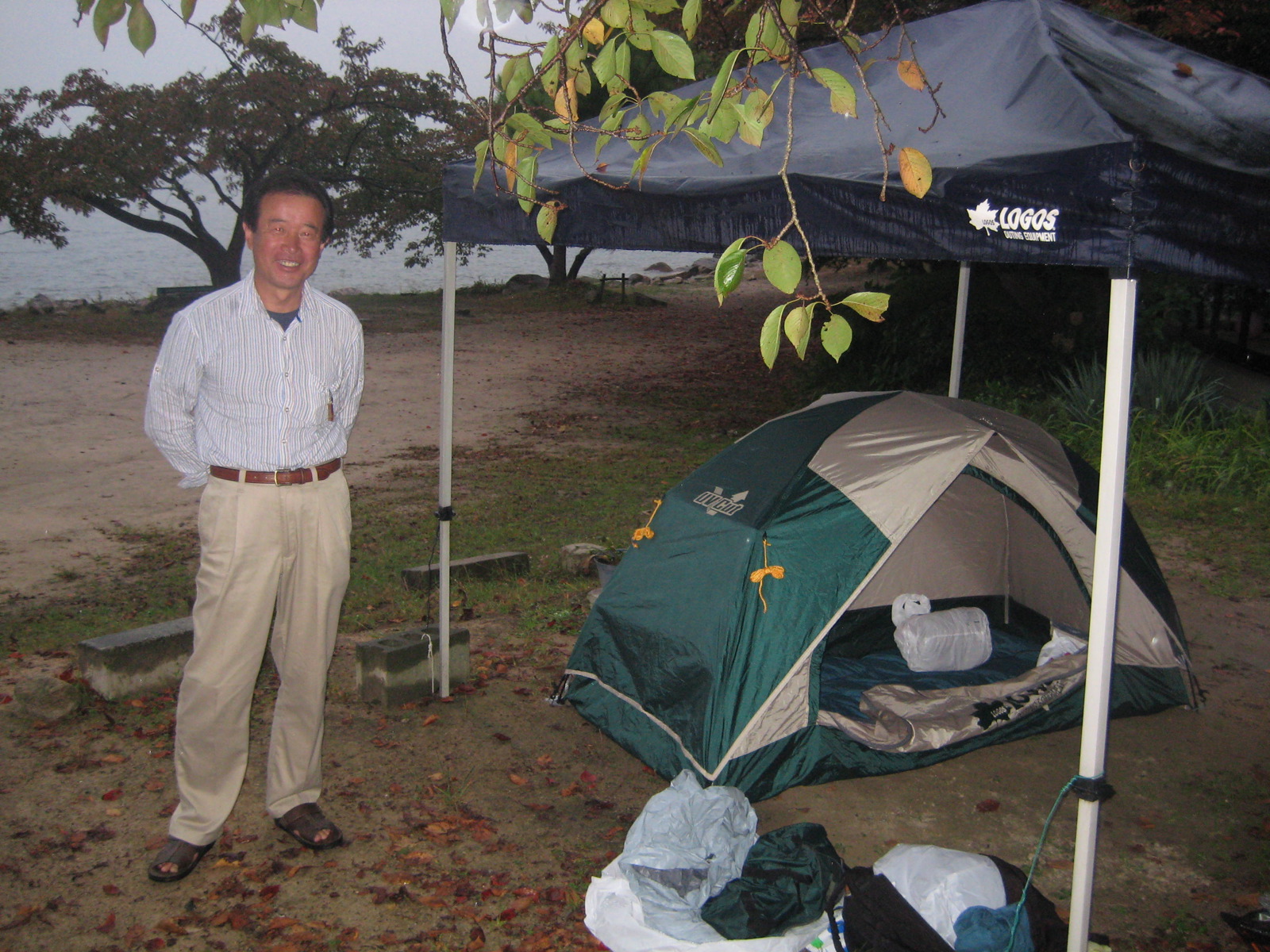
Then she points to a party tent standing there. If I put my tent up under it, it will stay dry. There is a hole in the tent but the tent is large enough for me to keep everything dry. Unless there is a flood tonight ...
Up to now, it has been very handy to have the man there. He has conjured up the woman, I now know that I really am on the camp-site, where the toilets are (in the shed) and where I can cook (a unit under a shelter).
I thank him with a lot of bows and an 'arrigato gozaismachita’, hoping he will now go away. However, he just stands there and watches me unload my bike.
When I get to the tent, he insists on helping me. One really shouldn’t have help putting up a tent, especially not a small one. But he insists.
So I let him and after some clumsiness, a lovely tent is standing under the party tent. The man nods approvingly but his face belies this: ‘and you do this for fun??’
And then, to my great surprise, the words of deliverance come: “Go home, wife, dinner”.
Hey, wait a moment. So he is now going home, where his wife is apparently waiting with dinner. He has come to help an unknown foreigner because he was worried and didn’t want to leave before he was sure everything was alright. I almost feel like apologising for my unwarranted suspicions. Sorry, sir, I didn’t realise that you only wanted to help and had forgotten I was in Japan.
Instead of that, I thank him profusely with many little bows and off he goes.
This afternoon I bought a packet of sushi at the supermarket, my ‘dinner’ for this evening. While I am eating, the camp owner comes along, together with a woman of about my age. I take her to be her daughter and think they want to know if everything is alright. They laugh about my pack of sushi. “Oisi!” I say. Good!
As it is raining and dark, I go straight to bed with a book. It has meanwhile started to blow harder. In the course of the evening, both Chiaki and Erico ring to see if everything is alright. Yes, fine. All these people who are worried about me and want to make sure it is really alright. What could go wrong?






Thursday, 23rd October, 2008
Distance cycled: ca. 120 km
Weather: rainy, cold
What a night. It rained the whole night and there was a lot of wind too. I had to do some ‘bailing’ several times during the night, relieving the roof of the party tent of a deep pool of water. Luckily everything remained upright.
It is still blowing very hard. For the first bit, I shall have the wind behind me but the rest of the 80 kilometres a head wind.
When I have packed everything, the owner and her daughter come out. They point to the sky and I nod in agreement. I believe they are sorry for me.
When I leave, they give me two cans of something to drink.
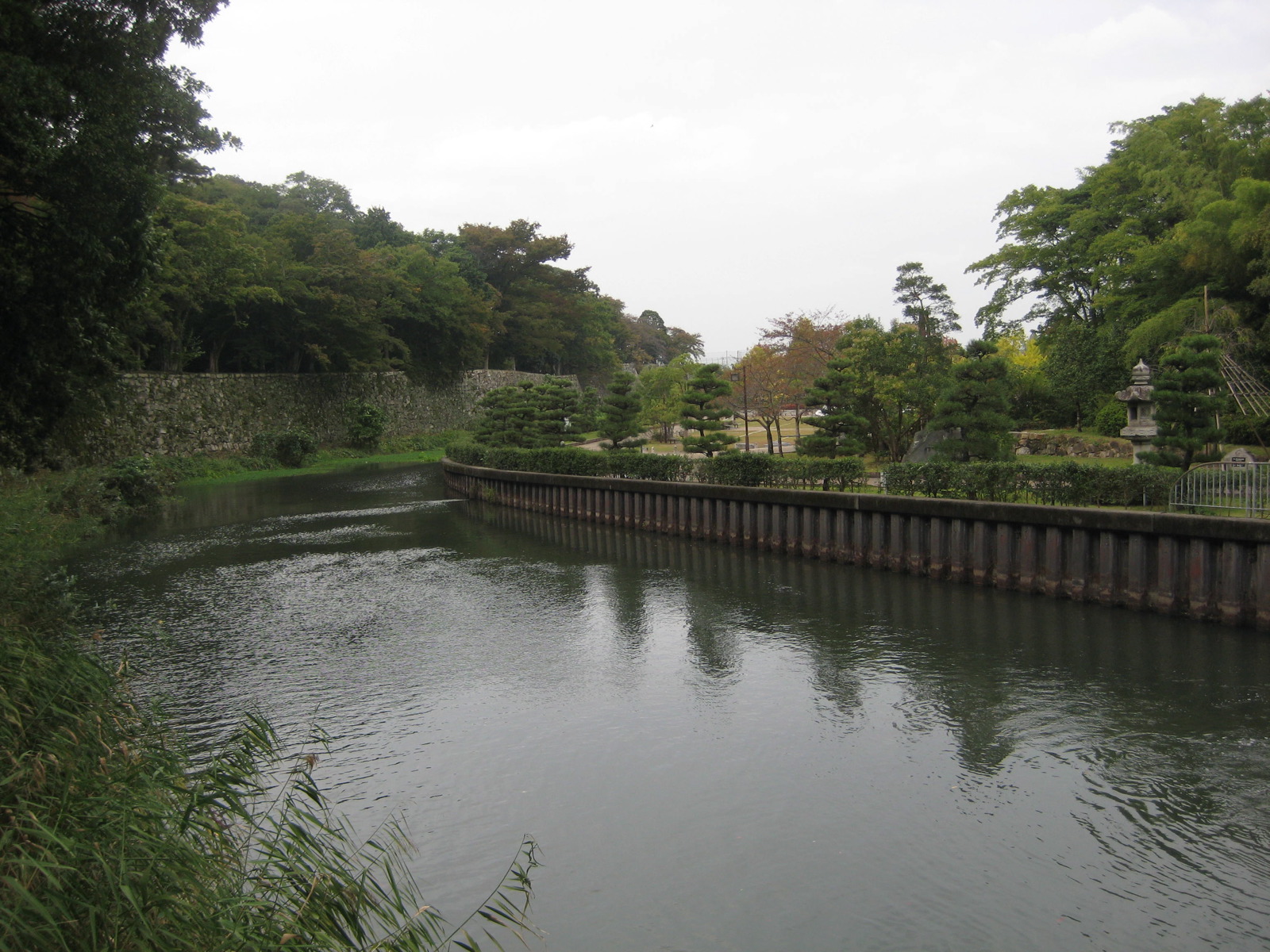
At the northern end of the lake there is a peninsula. An alternative cycle route goes round it. If I do that, it will be ten kilometres extra. I decide not to do this and ‘cut off’ the peninsula, following the official route. The description on the map says that this part is heavy going and with this weather it doesn’t appeal to me.
I haven’t been going for long when I come to another tunnel – a kilometre long. I gulp, but go bravely into it. After about ten metres, I suddenly feel anxious. I stop and look behind me. It is too dangerous to turn round. The path I am riding on is very narrow and if I turned the bike round, I would hit the cars that rush past. Slowly I walk the bike backwards. Once I am out of the tunnel, I scratch my head. What now? There is a turning further on. I see on the map that that road comes to the lake again and that I can regain the route there. Thank goodness. Relieved, I cycle on.
I decide to take a short rest. It has just stopped raining but that won’t last long. I take out the cans I was given by the camp-owner this morning. No idea what they contain, probably juice. I open the first one and take a big gulp. I’m really thirsty! I think it takes about two seconds before I taste what I have in my mouth. Disgustedly, I spit it out. It turns out to be cold coffee with sugar and milk. This is horrible, really horrible! I love coffee, but hot, please, and black. When I have recovered from my disgust, I try the second can. I open it carefully and smell it first. Hm ... I don’t smell anything. Then I take a tiny sip, then another and another. This is good! I don’t know what it is either but it tastes good.
It starts raining again and I cycle on.
After a bit, the road comes to a dead end. What’s this? A women of about 40 sees me looking round helplessly and I ask if she speaks English? She puts her hand to her mouth and starts giggling. Then she begins to talk to me in rapid Japanese, I look at her and shrug my shoulders, saying ‘sumiemasèn (sorry)’. ‘Americano?’ she asks. ‘Ollando’, I answer. She looks at my map and I point to the circumference of the lake. Shocked, she looks at my bike and then at me.
Then she points to the way back and, seeing this is the only way I can go, I cycle back again. At the first possible turning, I turn right and after some time I see the lake again on my right.
About an hour later, I hear someone calling: ‘Orrando-san, Orrando-san’. Surprised, I look round and see the same woman passing me in a car. She stops and gives me a can of juice. I thank her but she drives off again immediately, leaving me completely flabbergasted.
Luckily, there are many ‘picnic places’ where you can stop out of the rain. It is so cold and I am so wet that I put on a fleece jacket and wrap a fleece blanket round my legs. It is nearly twelve o’clock, maybe a little early for lunch, but I feel like having my rice balls.
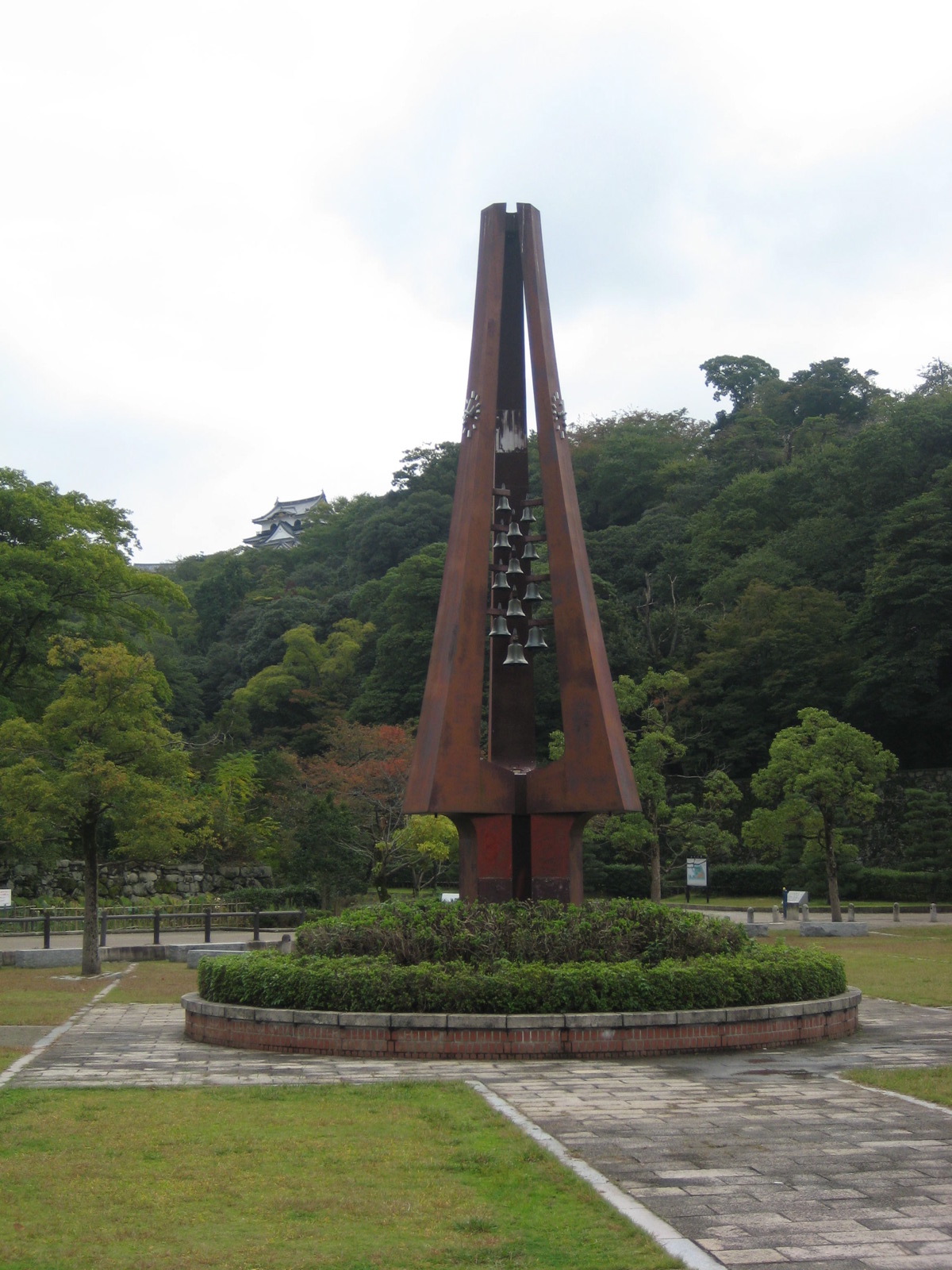
It is a nice, quiet spot. In spite of the cold, I enjoy the view, the quiet and the delicious rice balls. And then, quite unexpectedly, there is music. It is twelve o’clock: an instrumental version of Edelweiss (electronic) sounds from a loudspeaker.
I shake my head in wonder. Strange guys, the Japanese.
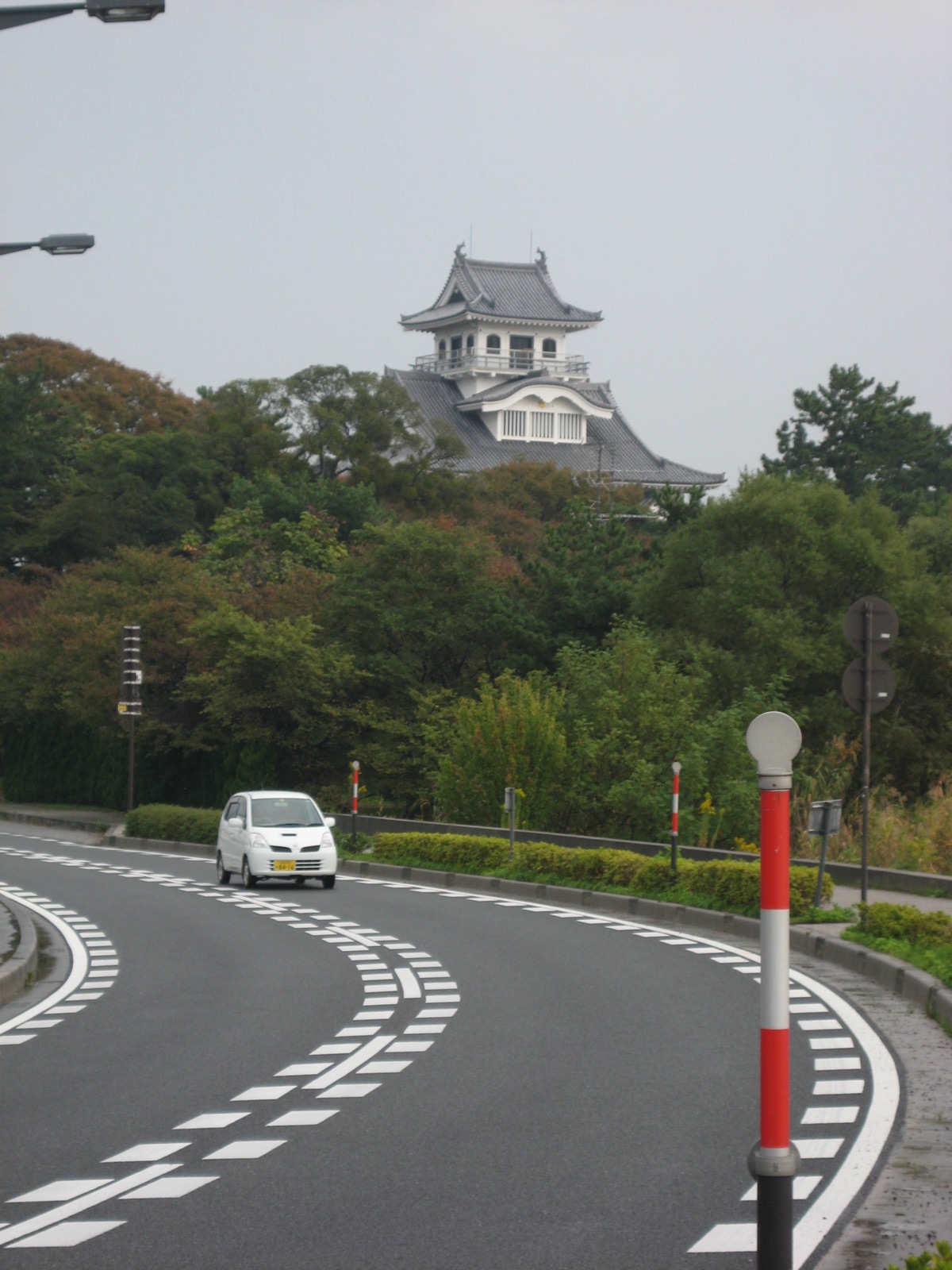
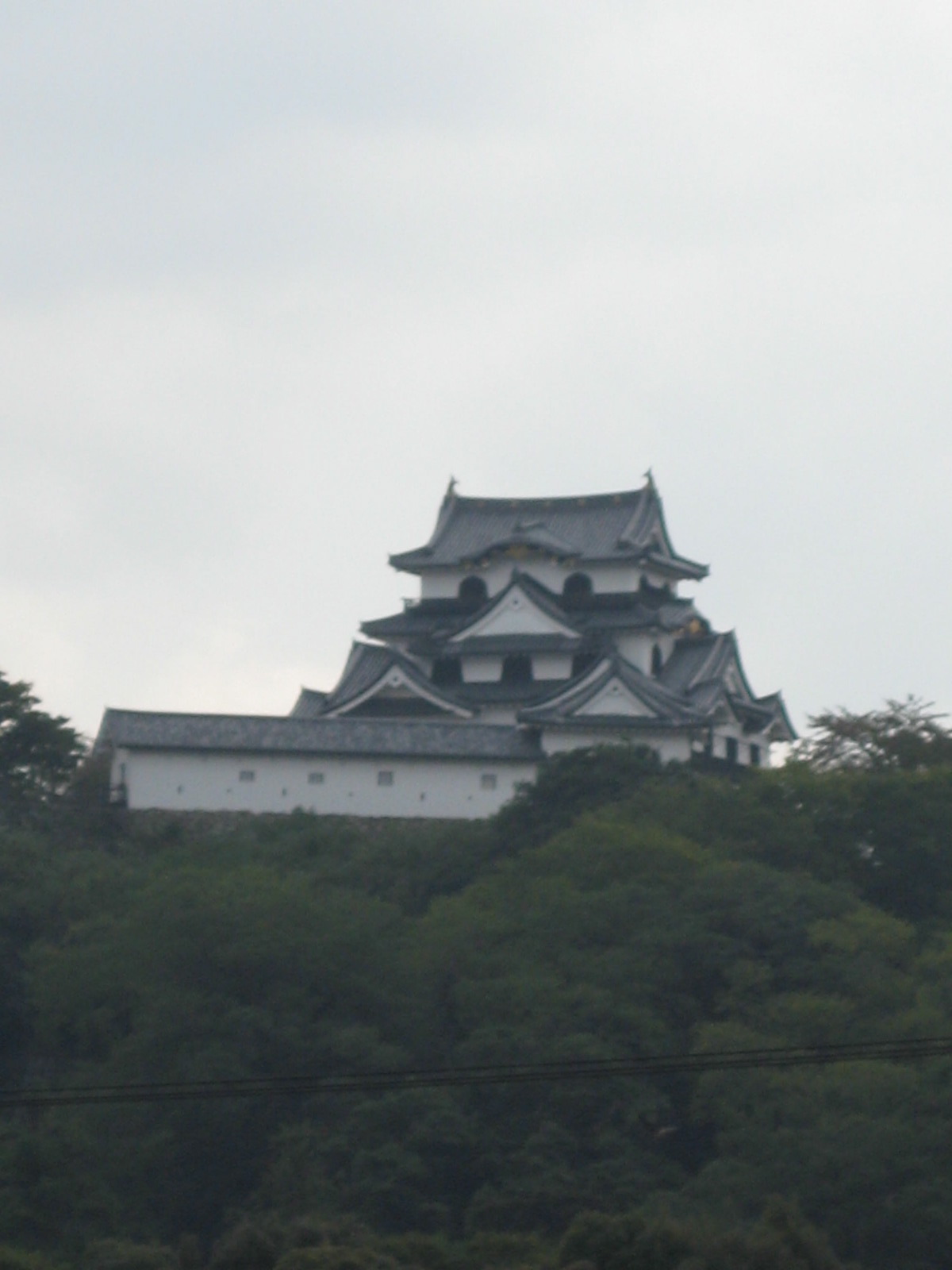
If I want to get home before dark, there is no time to visit the castle. I go to the ticket office to get some information on opening hours and prices. Maybe I can go there again later with Erico. It must be very nice and special to wander through a Japanese castle.




I’m ready for a rest. I do that quite often, to give my back, knees and shoulders a bit of a rest.
The can of juice that I got from the lady in the car turns out to have little taste. Never mind, as long as it’s not cold coffee. Just like in the lunch break, I again have a seat with a shelter. I walk to and fro a bit which is good for my back which is playing up. And, just as in the lunch break, I suddenly hear music. This time an instrumental version (electronic again) of Schubert’s ‘Sah ein Knab’ ein Röslein stehen’.
I decide not to be surprised by anything anymore as long as I am in Japan.
It is dusk when I get back to Moriyama. I know the way to Erico’s house but that is a long way round and by the time I get to the rice fields it is pitch dark. I don’t dare and can’t go through there then.
I still have the copy from the street atlas. I see that I must first go along a river for a bit and then along the railway. If that works, I automatically come to the station and Erico’s house.
But oh, how dark it is! There is hardly any street lighting (where have all those neon lights got to all of a sudden??) and I can hardly see through my glasses because of the rain.
I’m nearly home and then it gets very tense! If not ‘life-threatening’: broad gutters run along the streets and you can easily foul them on a bike. From time to time, I get off and walk for a bit. And when I then land in the middle of nowhere, instead of by the railway which should cross the road, I get a bit worried. Of course, I could ring Erico, but what’s the use? She is either still at work or on the way home and I can’t tell her where I am because I haven’t the slightest idea. No, she would only be worried. I cycle and walk back again until I find a road with the number 477 . Ah, that’s on the map. I cycle and walk alternately but after an hour I am rather dispirited. Surely I should have been in the centre long ago? I don’t get it. I go into a shop but they don’t speak a word of English. I show them the map. Maybe they can point to where I am now. The assistant studies the map carefully, turns it every now and again, but gives it back with a shrug.
I walk on. It is a busy road without a cycle path or lane and with gutters on the edge. Every now and again, I go into a shop or office. No use. Even if I say ‘Moriyama station’, they shrug or point all over the place.
I have just about given up when I go into a garage. A nice young man is standing behind the counter and even speaks quite a bit of English. He tells me that I am quite a long way from Moriyama station and that the place where we are now is not on the map. Not on the map??
“I’ll print some new maps for you from Google Maps”, the young man offers. I’m relieved and nod thankfully. Salvation is near, I’ll probably be home soon.
The man colours the road I must follow with a red pencil. At each crossing, he tells me what I shall find there: a petrol station, a Seven-Eleven store, a restaurant. Everything is named and written down. Wonderful, getting lost is almost impossible now.
The man points to the road we are now on. “The first crossing where you must turn off is about ten kilometres away”.
Pardon??? Did I understand that correctly? If I interpret the map properly, that means I still have about 20 kilometres to go. What a state of affairs ...
Well, there’s nothing for it but to get back on the bike and I thank the young man for his enormous help. He is certainly my hero for the day.
At last, after many, many kilometres, I suddenly hear the train very near. I think I know where I am – near Moriyama station. But I still need to look for the streets, which don’t seem at all familiar. I ask passers-by where the station is and see it a little later. But when I get nearer, my heart sinks into my boots. This isn’t Moriyama station. At that moment, the telephone rings. Erico. She is on the way home and asks where I am. I tell her I am at a station and am just trying to find out which one it is. Then I see ‘Ritto’. Good heavens, I have cycled right past Moriyama station! Now I have to go back five kilometres.
Anyway, I now know exactly where I am and how to get home (just follow the railway).
An hour later, I sit on Erico’s couch, exhausted. Phew, what a trip! But, except for the last few hours, I have thoroughly enjoyed it!

